My dear Jewish friend 17: Lederhosen, lessons of the past for a brighter future

– Updated Version (Aug 27, 16:50 GMT +2) : including Rick Landmans memories of his father –

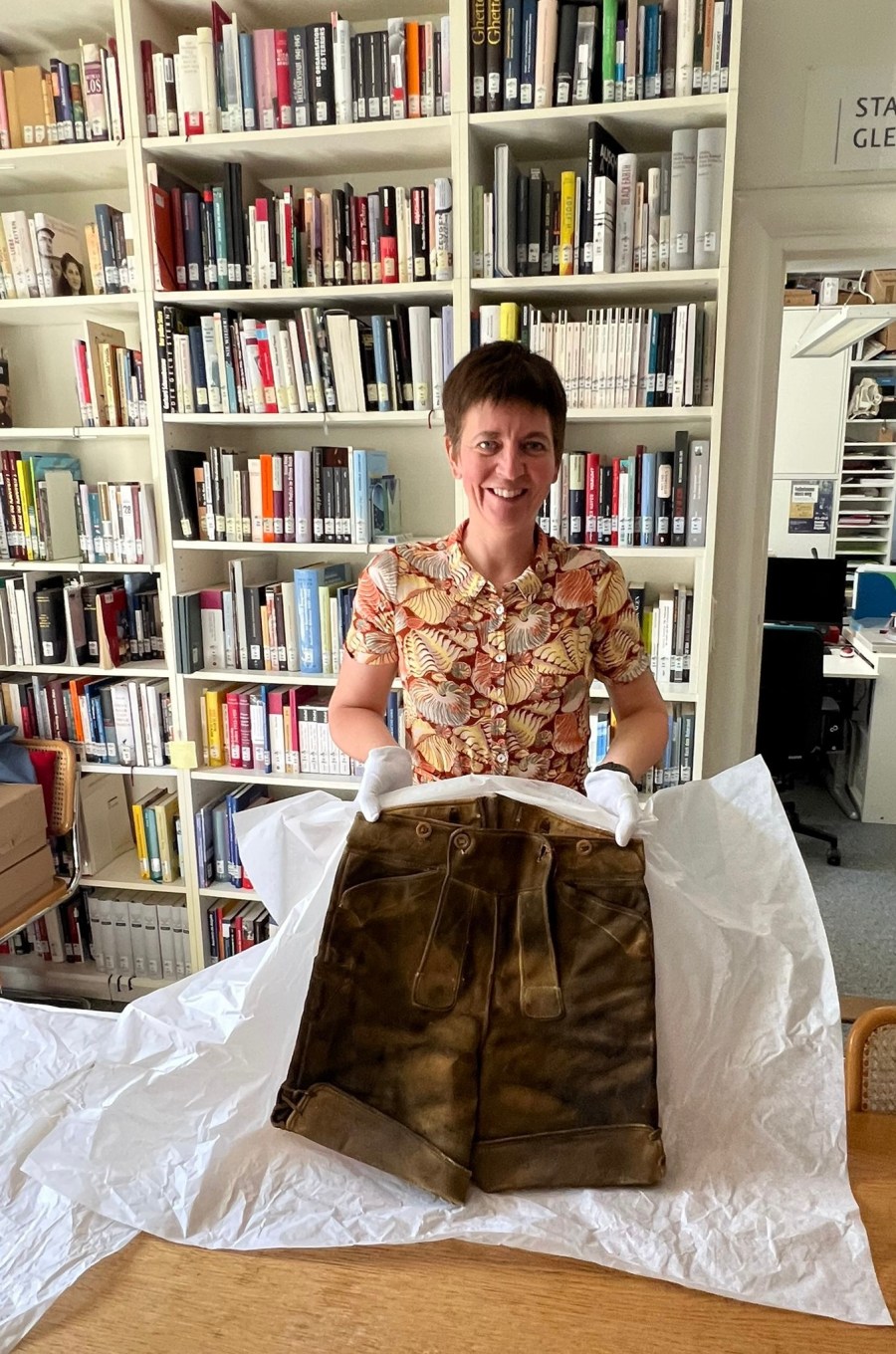
I stood in awe as I looked down at the brown lederhosen, which had been carefully placed in my hands. My gloved hands touched the matured leather. I could see by look and experience that this pair of German traditional clothing had been devotedly worn and looked after neatly as well. What I held in hands was the Lederhosen of Henry Landman. His son Rick, a dear friend, had told me about this special piece of clothing. Now Mrs. Müller, the deputy director of the Jewish Museum Augsburg Schwaben had especially brought it from the archives for me to see as I visited the museum on this hot August afternoon.

I was moved to tears, because it not only made me feel close to Rick, but held an important artefact of history in my hands. If the Lederhosen could speak, they would tell the hurtful, but ever so strong story of Henry Landman.

Rick Landman writes about this difficult chapter in his fathers life via Facebook:

The Gestapo arrested my dad on the day after Kristallnacht (November 10, 1938) at 5 am while he was still in bed. When he got up he put on his Lederhosen and when he reached Dachau he turned them in. They put them in a brown paper bag with his Dachau Number on it. When he was later released they returned them to him to be able to go home. His father who was released earlier was able to get him a Temporary Transit visit to get to London. He was 18 and too old for the Kindertansport.
On April 15, 1939, my dad as an unaccompanied teenager made his way to London and he either took the Lederhosen with him, or packed them in the lift that he sent to NYC the week before.
Growing up in NYC I remember my dad wearing them while doing the gardening. [If you check out my COMMENTS] you can see a photo of my dad trying on the Lederhosen before we sent them to the Museum, and a photo of me wearing my Lederhosen in the Catskills when I was a child.
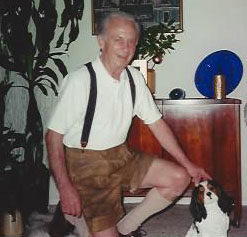
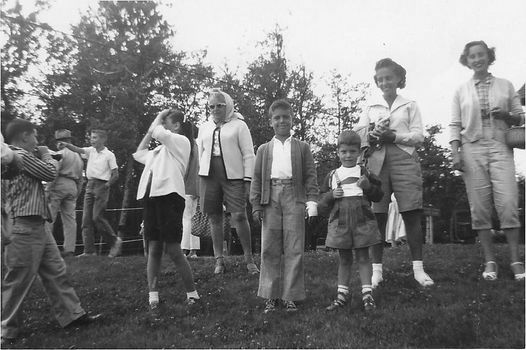
Rick Landman, via Facebook

Henry had been arrested in this very traditional German clothing I held in my hands many years later in Augsburg. At his release he was handed all his belongings back, which included the Lederhosen. Henry emigrated to the U.S. just in time and returned six years later in the very different clothing of a US-Soldier to Germany to liberate the Jewish people.

Father like son, Rick is a very inspiring person. On his website he gives touching insights in to his biography. For the 70th anniversary of the liberation of Dachau he wrote for the „Gedächtnisbuch für Häftlinge des KZ Dachau“ about his late fathers experience as a liberator of Dachau:

[…] In 1945, the town of Dachau had one major road with a few side streets off to the sides.  When he arrived the street was full of people shouting, eating, looting, and running around either in exuberance of their new freedom or fear of what will happen next.   Colonel Porter gave him a jeep, and while riding down the street, a woman in a long black dress jumped into the middle of the street waving her hands trying to get my father’s attention. His jeep stopped and my father hopped out in his U.S. Army uniform, carrying his rifle and went up to her asked her what she wanted.  Her face showed a combination of urgency and fear, but she calmed down and motioned him to go with her into a small house with a bakery on the ground floor.  She wanted to get off the street before she would tell him why she was so frantic.  When inside, she explained that someone was hiding downstairs who wanted to surrender directly to an American soldier.  She said that she just wanted him out of her house and didn’t know what to do.

The man who ran into her store was still wearing his S.S. uniform and was more afraid of the newly liberated concentration camp prisoners than he was of the U.S. Army.  My father went down a spiral staircase pointing his rifle as he slowly descended, and there hovering in the corner, was probably a former Captain in charge of the S.S. officers at Dachau Concentration Camp.  When the Nazi officer saw my father, he stood up and saluted him with an American salute and he said that he wanted to surrender to an American, and be away from the mob of former inmates.  The whole thing was so bizarre to my father who could still remember being in Dachau as an inmate.  Even if this man was not the same Captain as in 1938, the thought of my father being the savior of an S.S. officer was quite ironic.  In retrospect, my father wondered if the Captain was actually the son of the screaming woman, and she tricked him into saving her son.

My father didn’t explain who he was and why he spoke German and just let them wonder if all of the U.S. soldiers were as conversant as he.  The Captain walked upstairs with his hands over his head, and then my father and the other soldier who was watching the jeep put the Captain on the hood of the jeep and told him to hold on to the metal bar that was attached to the front bumper.  This bar was the latest invention of the Americans to try to keep them from being decapitated.  The Germans would tie a thin wire around a tree on one side of the street and then cross the street and tie it to another tree, hoping that the American soldiers in the convertible jeeps would ride by and have their heads sliced off.

My father didn’t have to worry this day about any decapitation.  In addition to the outreaching metal stick, he had a Nazi officer in the front who would feel any wire before they would.  As my father drove down the main street of Dachau with this prominent Nazi on the hood, he remembered that six years earlier he was released from Dachau and was told that he better get out of Germany, because the next time he ended up in that camp, he wouldn’t be getting out alive.  Now six years later, he was an American soldier saving the life of a man in charge of all that killing.

Rick Landman, https://www.gedaechtnisbuch.org/henry-heinz-landman-and-70/

Such remarkable and moving experiences – I do not know, how Henry was able to see it all through. Both, the Lederhose I was allowed to see on this remarkable day in August, and the jacket of Henry Landman´s uniform, are in the safe keeping of the Jewish Museum Augsburg Schwaben as an important reminder of history. While this part of history is well documented thanks to the Landman family, Rick and I want to work on reconciling the broken past of our Franconian home town.

You have to meet him! He’s only a few miles away in Manhattan. What a delight it would be, to connect two of my favourite people and maybe someday have both of you with us here in Germany as we try to reconcile history through friendship and important lessons of the past for a brighter future.

My dear Jewish friend 8: Remembering and committing as Police

I carefully placed the large candles on both sides of the table, then arranged the white framed picture, book and the program in the center. As the candles burned I waited in the quietness of the morning for my colleagues for the briefing and the following holocaust remembrance. For me it was a tripple commitment as a German citizen, Christian pastor, and now working for the Federal Police since almost a year. The epaulet with a golden cross on my shoulder visiualized my double responsibility for the church and the Federal Police.

When I broke the news to you over a year ago that I would be leaving New York to be called to the Federal Police we shed tears. We instantly knew that something special would very soon be no longer part of our routine: the strolls in our neighbourhood chatting about our lives, working together in your food pantry for the poor, and sharing joy, laughter, and tears.

Even though I still can’t get used to be so far away – to be exact 3.923 miles – this January morning gave me the feeling that our pain of distance at least makes some sense as I remembered with other leading police officers the crimes of the Holocaust. When the Police director spoke of the responsibility remembering and committing to never forget what had happened to your people and so many others during the Nazi horrors, my heartbeat increased. I was proud to hear that the German Police, which was complicit like many other institutions including my Bavarian Lutheran Church, commits to securing human rights and the German constitution.

This commitment is central as I teach young police trainees in ethical decision making. But let me try to briefly recall what happened back then with policing making the Police force a significant element of the muderous Nazi-regime. (For further information follow the link to the German article about Policing during the Third Reich)

The rise of the Hitler movement began against the background of economic and
political crisis of the Weimar Republic. The brutal regime took advantage of the difficult situation of million Germans. Hitler and others in power legally created system of injustice that was aimed at installing a National Socialist-oriented community, which was „liberated“ from any „un-German spirit“.

Essential feature was the so-called „Verreichlichung“, in which the Police force was centralised by the Nazi rulers and became its outward appearance through the „Reichssicherheitshauptamtes“ (Reich Security Main Office) in 1939. From spring 1933 until the end of the war in 1945 the police apparatus received extensive new possibilities to intervene and monitor. In addition, the boundary between „law enforcement“ and „security police“ become blurred in favour of the SS, which ultimately held all powers. To make things worse, the population supported the daily terror of the Secret State Police by
willingly denunciating their fellow citizens.

Police battalions and task forces not only took part in the organisation of the Holocaust in the Germany and occupied areas, but were involved in mass shootings in East Europe and therefore directly took part in the Nazi genocide.

After celebrating six very meaningful Holocaust Remembrance Days in New York, it was this day that added an important mew layer to my commitment as a German citizen, and a pastor working in and for the German Federal Police. May we learn from the disaster of the Holocaust to never make it happen again to anyone, no matter what religion, nationality, or skin color the person might have.

The Sound of Broken Glas under my feet

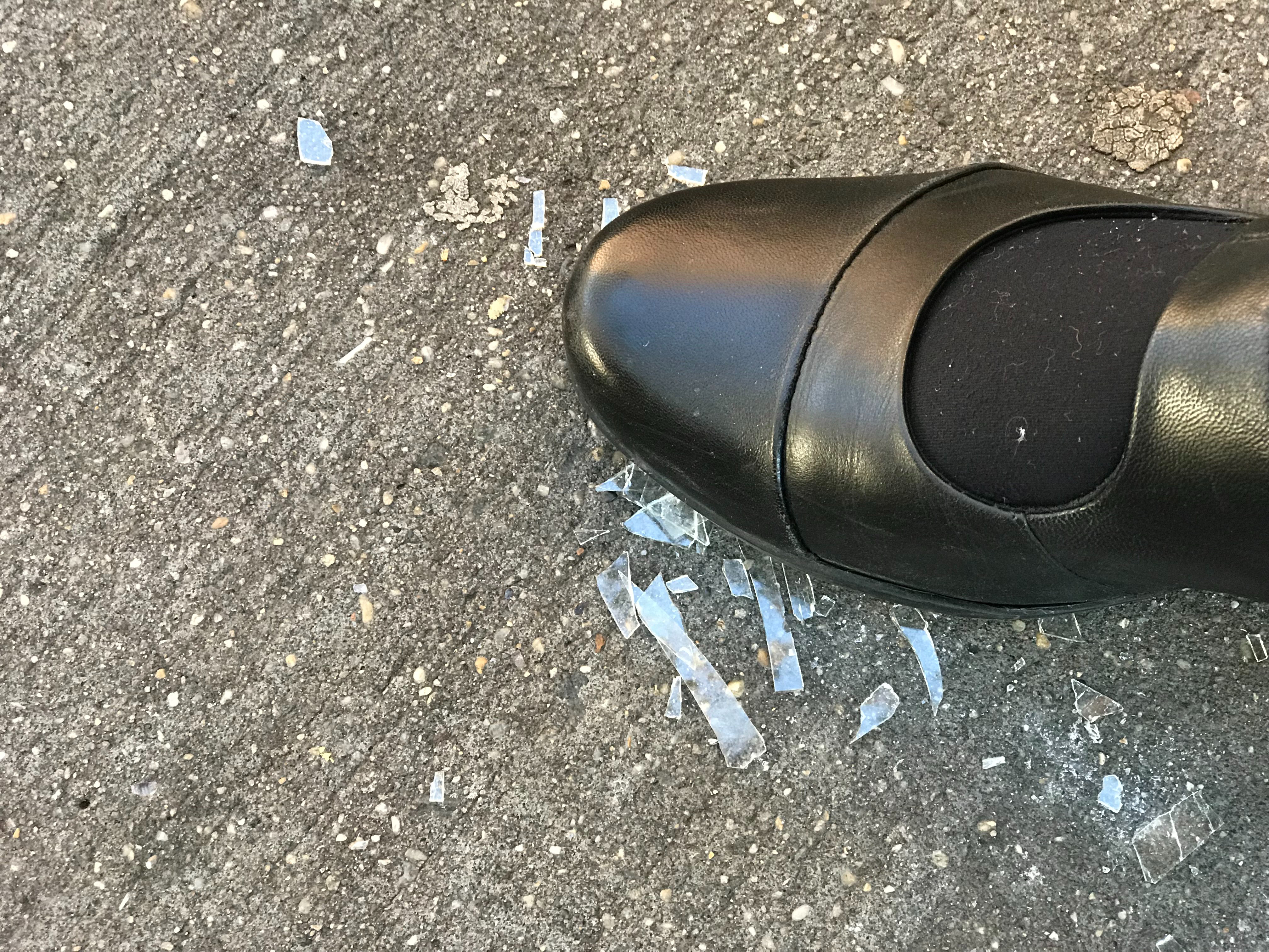
As my heels touched the sidewalk the sound of broken glas sent a cold shiver down my spine. The words of Ruth Zimbler, who had experienced Kristallnacht  as a ten year old Jew in Vienna, Austria, echoed through my mind: „The sound of broken glas under my feet haunts me every day.“

2018-11-04 09.05.22

Here I stood as a Lutheran pastor in front of our small German Lutheran Church in Chelsea and couldn’t move one bit as the nightmare of the Kristallnacht haunted me in a unexpected way on this bright and sunny Sunday morning. In not even a weeks time it would be 80 years since Germany exploded in an orgy of unbelievable violence. As businesses and synagogues were destroyed. „This night of horror, a retreat in a modern state to the savagery associated with bygone ages, laid bare to the world the barbarism of the Nazi regime. Within Germany, it brought immediate draconian measures to exclude Jews from the economy, accompanied by a restructuring of anti-Jewish policy […]“ (1)

It took the Hitler´s regime over five years until it showed its ugly face of destruction and hate to the world. Up to this point hate crimes had been steadily on the rise. The acceptance of these incidences grew into the normality of a steadily increasing number of Nazi-supporters, who were numbed by Hitler´s words and perspectives of work and bread through a increasingly busy rearming economy.

The political underdog Hitler had at last succeeded. After Hindenburg had brought him into office in January 1933, he had steadily built up a system of expansion based on the suffering of millions. His speech in front of SS leaders in early November 1938 had sparked deep hate and named the blameworthy people: Jews, freemasons, Marxists, and the Churches of the world were the enemies of his system of expansion (and mass destruction). Hitler pointed towards the Jewry as the driving opponents against his plans of „German grandness“.

This speech unleashed the terrors of Kristallnacht over Germany and Austria, and marked the official begin of unprecedented suffering and terror. The SS, the fire services, the police and other instruments of law and order, looked the other way – becoming instruments of terror and murder themselves.

The signs had been there from the beginning as Hitler was instated as Reichskanzler bei Hindenburg. Back then, numerous politicians thought, they´d be able to contain him and influence his political actions through a strong system. On his sixth anniversary of his takeover of power, Hitler publicly announced his evil plans to the public, which were received with great joy. The derided prophet had at last succeeded: „I have very often in my lifetime been a prophet,“ he declared, „and a mostly derided. In the time of my struggle for power it was in the first instance the Jewish people who received only with laughter my prophecies that I would some time take over the leadership of the state and of the entire people in Germany and then, among other things, also bring the Jewish problem to its solution. I believe that this once hollow laughter of Jewry in Germany has meanwhile already stuck in the throat. I want today to be a prophet again: if the international finance Jewry inside and outside Europe should succeed in plunging the nations once more into a world war, the result will be not the bolshevization of the earth and thereby the victory of Jewry, but the annihilation of the Jewish race in Europe!“ (2)

This political speech soon became a bitter reality as slow beginnings and normalization of hate numbed a whole nation. The „derided“ prophet had at last succeeded in his evil doings.

May we be warned by history about those, who draw their diabolical strength and dehumanizing power as they gather followers for their evil deeds around them. May we be „upstanders“ and not „bystanders“, as Ruth Zimbler had urges us to.

I tried to rub the shattered glas from my heels on the Church entrance, but with every new twist and turn of my foot they had dug themselves deeper into the shoe sole. I halted in my movement. Maybe they would be a fitting reminder for me as a German speaking pastor reminding me of the necessary commitment to stand against any hate crime in action.


(1) Ian Kershaw, Hitler. A Biography, New York 2008, p. 449.

(2) Ibid., p. 469.