My dear Jewish friend 17: Lederhosen, lessons of the past for a brighter future

– Updated Version (Aug 27, 16:50 GMT +2) : including Rick Landmans memories of his father –

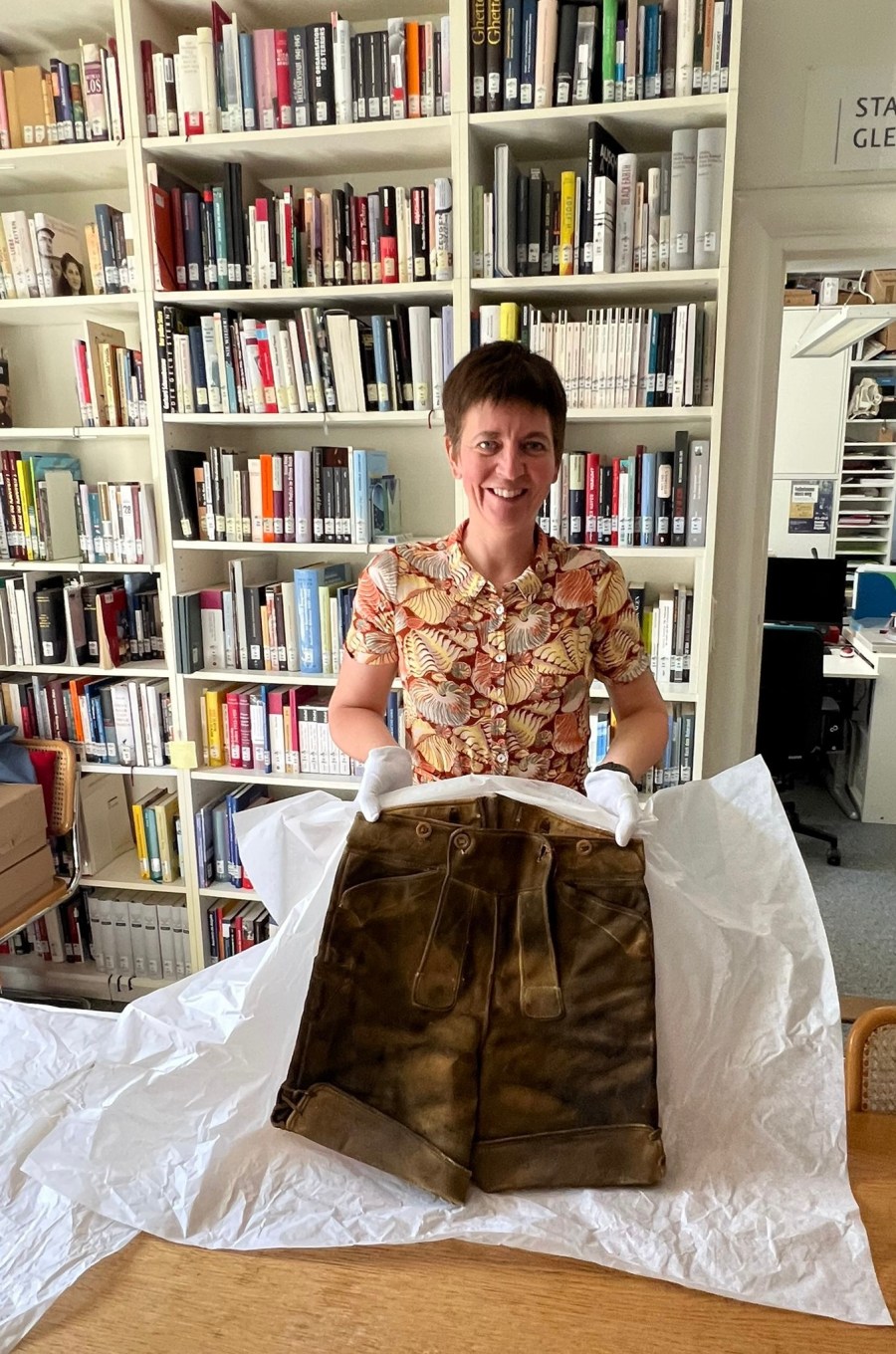
I stood in awe as I looked down at the brown lederhosen, which had been carefully placed in my hands. My gloved hands touched the matured leather. I could see by look and experience that this pair of German traditional clothing had been devotedly worn and looked after neatly as well. What I held in hands was the Lederhosen of Henry Landman. His son Rick, a dear friend, had told me about this special piece of clothing. Now Mrs. Müller, the deputy director of the Jewish Museum Augsburg Schwaben had especially brought it from the archives for me to see as I visited the museum on this hot August afternoon.

I was moved to tears, because it not only made me feel close to Rick, but held an important artefact of history in my hands. If the Lederhosen could speak, they would tell the hurtful, but ever so strong story of Henry Landman.

Rick Landman writes about this difficult chapter in his fathers life via Facebook:

The Gestapo arrested my dad on the day after Kristallnacht (November 10, 1938) at 5 am while he was still in bed. When he got up he put on his Lederhosen and when he reached Dachau he turned them in. They put them in a brown paper bag with his Dachau Number on it. When he was later released they returned them to him to be able to go home. His father who was released earlier was able to get him a Temporary Transit visit to get to London. He was 18 and too old for the Kindertansport.
On April 15, 1939, my dad as an unaccompanied teenager made his way to London and he either took the Lederhosen with him, or packed them in the lift that he sent to NYC the week before.
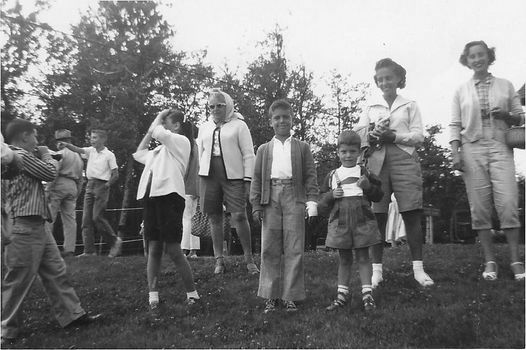
Growing up in NYC I remember my dad wearing them while doing the gardening. [If you check out my COMMENTS] you can see a photo of my dad trying on the Lederhosen before we sent them to the Museum, and a photo of me wearing my Lederhosen in the Catskills when I was a child.
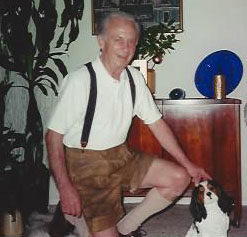
Rick Landman, via Facebook

Henry had been arrested in this very traditional German clothing I held in my hands many years later in Augsburg. At his release he was handed all his belongings back, which included the Lederhosen. Henry emigrated to the U.S. just in time and returned six years later in the very different clothing of a US-Soldier to Germany to liberate the Jewish people.

Father like son, Rick is a very inspiring person. On his website he gives touching insights in to his biography. For the 70th anniversary of the liberation of Dachau he wrote for the „Gedächtnisbuch für Häftlinge des KZ Dachau“ about his late fathers experience as a liberator of Dachau:

[…] In 1945, the town of Dachau had one major road with a few side streets off to the sides.  When he arrived the street was full of people shouting, eating, looting, and running around either in exuberance of their new freedom or fear of what will happen next.   Colonel Porter gave him a jeep, and while riding down the street, a woman in a long black dress jumped into the middle of the street waving her hands trying to get my father’s attention. His jeep stopped and my father hopped out in his U.S. Army uniform, carrying his rifle and went up to her asked her what she wanted.  Her face showed a combination of urgency and fear, but she calmed down and motioned him to go with her into a small house with a bakery on the ground floor.  She wanted to get off the street before she would tell him why she was so frantic.  When inside, she explained that someone was hiding downstairs who wanted to surrender directly to an American soldier.  She said that she just wanted him out of her house and didn’t know what to do.

The man who ran into her store was still wearing his S.S. uniform and was more afraid of the newly liberated concentration camp prisoners than he was of the U.S. Army.  My father went down a spiral staircase pointing his rifle as he slowly descended, and there hovering in the corner, was probably a former Captain in charge of the S.S. officers at Dachau Concentration Camp.  When the Nazi officer saw my father, he stood up and saluted him with an American salute and he said that he wanted to surrender to an American, and be away from the mob of former inmates.  The whole thing was so bizarre to my father who could still remember being in Dachau as an inmate.  Even if this man was not the same Captain as in 1938, the thought of my father being the savior of an S.S. officer was quite ironic.  In retrospect, my father wondered if the Captain was actually the son of the screaming woman, and she tricked him into saving her son.

My father didn’t explain who he was and why he spoke German and just let them wonder if all of the U.S. soldiers were as conversant as he.  The Captain walked upstairs with his hands over his head, and then my father and the other soldier who was watching the jeep put the Captain on the hood of the jeep and told him to hold on to the metal bar that was attached to the front bumper.  This bar was the latest invention of the Americans to try to keep them from being decapitated.  The Germans would tie a thin wire around a tree on one side of the street and then cross the street and tie it to another tree, hoping that the American soldiers in the convertible jeeps would ride by and have their heads sliced off.

My father didn’t have to worry this day about any decapitation.  In addition to the outreaching metal stick, he had a Nazi officer in the front who would feel any wire before they would.  As my father drove down the main street of Dachau with this prominent Nazi on the hood, he remembered that six years earlier he was released from Dachau and was told that he better get out of Germany, because the next time he ended up in that camp, he wouldn’t be getting out alive.  Now six years later, he was an American soldier saving the life of a man in charge of all that killing.

Rick Landman, https://www.gedaechtnisbuch.org/henry-heinz-landman-and-70/

Such remarkable and moving experiences – I do not know, how Henry was able to see it all through. Both, the Lederhose I was allowed to see on this remarkable day in August, and the jacket of Henry Landman´s uniform, are in the safe keeping of the Jewish Museum Augsburg Schwaben as an important reminder of history. While this part of history is well documented thanks to the Landman family, Rick and I want to work on reconciling the broken past of our Franconian home town.

You have to meet him! He’s only a few miles away in Manhattan. What a delight it would be, to connect two of my favourite people and maybe someday have both of you with us here in Germany as we try to reconcile history through friendship and important lessons of the past for a brighter future.

My dear Jewish friend 12: hygiene, human dignity and daily reminders

My hand softly touched the thick glass of the exhibition. I swallowed deeply as a huge knot of grief and anger formed in my stomach. No, it couldn’t be … but deep in my heart I knew it had happened. The small safety razor and its blades in the small glass cabinet looked so innocent and ordinary. Nonetheless, it was a silent witness of crimes unimaginable and executed on innocent people. What had started as a trip with my police cadets to the memorial of the concentration camp of Flossenbürg, took an unforeseen personal turn that would from then onwards be a constant reminder in my daily routine.

Just a few weeks ago I had bought a safety razor. One of these „old style“ ones, where you could detach the double-edged blade while the rest would be reused. I wanted to preserve the environment and thought to myself: Why not first start with my daily routines? Small actions that cumulate make a big difference.

On that wintery October day it hit me directly into my face as I saw a double-edged razor with separate blades that almost looked identical to the one laying in my bath room. I couldn’t take my eyes of this device of daily hygiene, which once according to the description belonged an prisoner of the concentration camp Flossenbürg. It was taken away as an action of discrimination. Hygiene was not allowed in these death camps. What is natural to us – a nice shaved beard, neatly cut hair, hygiene of other body parts – was taken away from prisoners as an instrument of oppression and terror.

Hair is such an essential part of our human dignity. A part of our personal expression of self. The Nazi terror went further. It not only took away double-edged razors, which ensured a personal self-administered hygiene, like the one exhibited in Flossenbürg, but brutally stole human dignity by shaving the hair of every person entering with straight razors and replacing names by numbers. Those ensuring this terror were part of the „Schutzstaffel“, which in 1936 was united by Himmler with the police.

As I pointed my young police cadets to the small glass cabinet with the double-edged razor, they were equally astonished to see a hygienically product laying there, which is now very much in fashion. Many had bought one themselves to show that they would try to preserve the environment. Now it is an unforeseen reminder in their and my daily private routine. Every young police cadet, who is impacted by an encounter with the evil, murderous regime that took millions of innocent lives, is one ally more and a sign of hope in our broken world.

Zu Gast bei Initiative 27. Januar

Am Abend des Epiphanienfestes war ich zu Gast bei Initiative 27. Januar. Im neuen, modernen Talkformat bei Instagram durfte ich mit Herrn Matthias Böhning meine biografischen und theologischen Zugänge zu Friedens- und Versöhnungsarbeit, Rassismus und Antisemitismus in Übersee und Deutschland sprechen. Es war eine spannende Unterhaltung, die mir sehr viel Spaß gemacht hat. Ich danke Herrn Böhning sehr für diese Einladung und lege die Initiative allen Leserinnen und Lesern ans Herz! Mitmachen könnt ihr bereits jetzt ganz konkret durch die Unterstützung des Projekts „Weiße Rosen und Briefe für Holocaustüberlebende“ (Link).

Hier ist der Zugang zum Video, der auf IGTV gepostet wurde:

How Society gets used to Injustice

Every morning the newspaper is delivered to our drive way. It is the same procedure every day. I wait until the yellow school bus swallows our children and the door close with the same squeaking noise. Then I bend down and pick up my daily portion of news wrapped in a dark blue plastic bag.

As I opened todays paper and flipped through the pages a almost silent thought crept into my mind getting louder and louder with every new page I turned. A campus shooting in Texas, that had been a rather casual side note in TV last night, was not even worth a mention in todays edition. I couldn’t believe, how quickly one gets used to certain kinds of news.

This kind lack of information mirrors human behavior: The human mind gets quickly used to certain occurrences. In January 2020 there were 28 mass shootings costing 38 lives. Only few nowadays make it to the headlines. That was different, when I was a child. I still vividly remember the first mass school shooting in Germany.

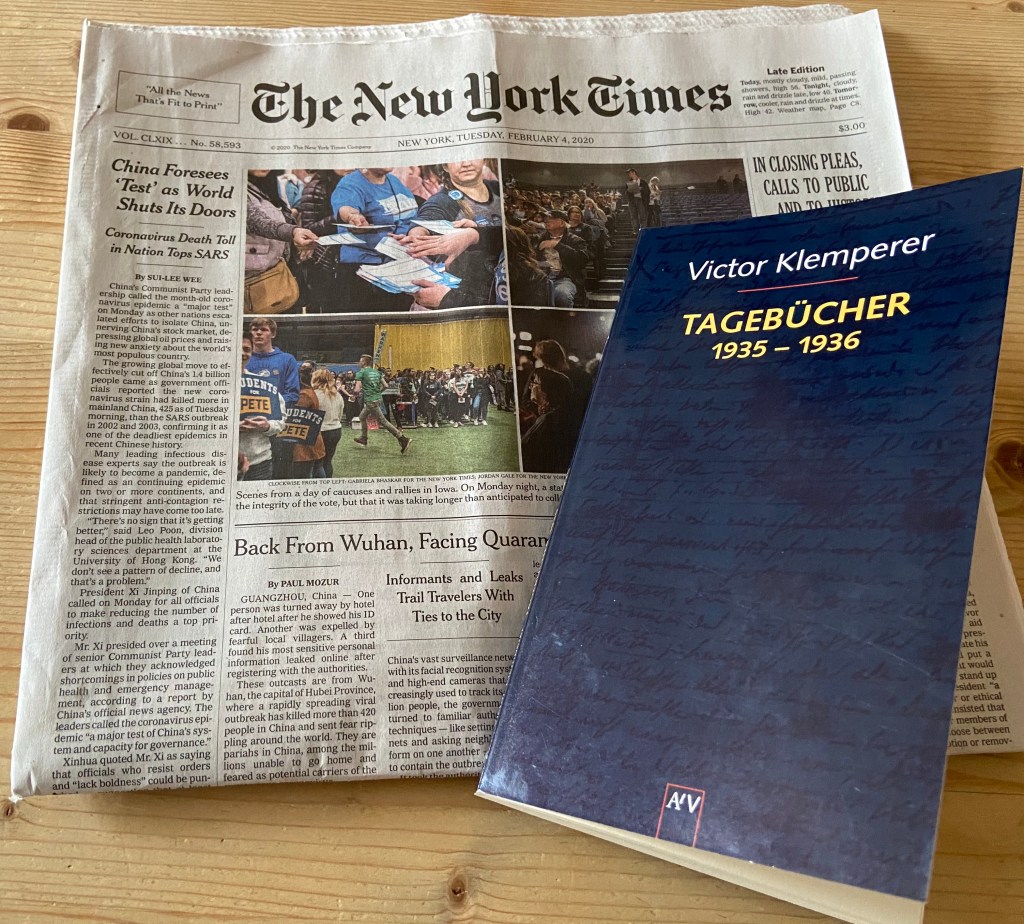
As quickly as life and routines change, the way we see the world and what we perceive as dangerous, just or unjust seems to shift. Victor Klemperer (9 October 1881 – 11 February 1960), a German native and language scholar, experienced this shift of conscience in a very personal way. His diary tells us in details about his life under the Nazi dictatorship and is a frightening documentation of a shift in mind and ethics enabling the most destructive regime ever haunting the face of our earth.

These shifts never come abruptly. More so, they quietly make their way into society. Changing habits, thoughts, and mind-sets in small steps. Almost unnoticeable. They crawl into news, everyday life, conversations, and increasingly change how we perceive things. What formerly was branded as unjust, is after a while met with indifference, and later will even be seen as a just decision.

It was February 21, 1935. Victor Klemperer awaited the visit of two students. As a son of a Jewish parent he had lost his call as a University professor due to Adolf Hitler´s racial laws. Now he was forced into retirement and isolated from his highly active life as a renown scholar and teacher. Any kind of normality was happily welcomed by him and his wife reminding them of the life they had before the Nazi regime took its deadly grip of Germany. But the normality that entered his quiet, isolated home through two former students opened his eyes to the gradual disappearance of what he once called normality:

The girls are completely anti-Nazi. But when it came to talking about two young noble women who had just been executed in Berlin for espionage (for Poland, the friend!), they thought it was all right. They did not ask about the difference between peace and martial law, security through public negotiations, etc. The sense of justice is lost everywhere in Germany, is systematically destroyed.

Victor Klemperer, Tagebücher 1935-1936, Berlin, Germany 1998, p.15 (translation: Miriam Groß)

Miss Winkler and Miss Hildebrandt had been two average young students, who hadn’t supported the Nazi regime. Nonetheless, they too were changed gradually with what they perceived as just or unjust. They stand for millions of average Germans, who had not enthusiastically embraced Hitlers thoughts, but opened the gates to destruction through their increasing shift in the sense of justice. A bitter warning, Victor Klemperer left behind through a small remark in one of eight diaries describing the year 1935.

What was unjust yesterday, is perceived as normal and soon will be deemed just. Harsh sentences, brute words tweeted quickly without thinking sow the seeds of indifference and later hatred. Back then during the Nazi regime it started of with the normalization of violent slurs against Jews. And then escalated into the murder of millions of innocent people.

We should stay woke! Victor Klemperer´s diary is a important warning. May our sense for justice never again be lost. May it not be systematically destroyed as once in Germany.

I am afraid, this will take the courage of many to speak up and show that they are not indifferent towards any kind of totalitarianism. It will come at a high personal cost, but so be it.

False messiahs, votes, and hopes for the future

A sigh of relief passed my lips as I opened my absentee ballot that had just come with our daily mail. It had been some journey to exercise the rights of my German citizenship: After applying in April the ballot finally arrived two weeks before the election. As I opened the grey envelope, perfect German structure greeted me while my mind wandered of to the consequences of my vote and that of 82 Million German citizens. Even though nobody really expected a political messiah, many of those near to me set their hopes on the main stream parties. And I must admit, the rather uneventful political campaign without any major scandals had a consoling effect on me. But these quiet and intellectual campaign trails have not always been part of Germany´s political makeup.

When Hitler headed for being reelected in November 1933 a incredibly accurate planned show was orchestrated by Hitlers Propaganda minister Goebbels. In many ways it had particularly similar elements of a boastful and arrogant attitude, which was exposed during the last US-American campaign for the oval office. The loud outward appearance was even called by some „American style“. Victor Klemperer diary entry from Nov 11, 1933 is a shocking and insightful reminder of this time:

„The excessive propaganda for the “ Yes“. On every business car, postal car and bicycle , at every house and shop window, on wide banners stretched across the street – everywhere slogans by Hitler and always „yes“ for peace. It is the most unbelievable of all hypocrisies. We want more soldiers to make the army to the militia and to blend with the million of SA [Sturmabteilung]. Parades and choruses until into the night, loudspeakers on the streets, music cars (with on the top mounted radios), cars like trams.

Yesterday from thirteen to two o’clock the „festive hour“. „In the thirteenth hour Adolf Hitler comes to the workers.“ Perfect the language of the Gospel. The Redeemer comes to the poor. And in addition the America-appearance. The sirens‘ haul, the minute of stillness […] A highly skilful, calmly spoken report on the disposition by Goebbels, and then about forty minutes of Hitler. A generally hoarse, overwhelmed, excited voice, wide passages in the vindictive tone of the preaching sectarian. Content: I know no intellectuals, citizens, proletarians – only the people. Why have millions of my enemies remained in the country? The emigrants are „rascals“ like the brothers Rasser. And a few hundred thousand rootless international – interjection: „Jews!“ – want to oppose millions of people. I only want peace, I have risen from the low people, I do not want anything for myself, I have three and a half years‘ full power and do not need a title. You must say yes for your sake. […] The man [Hitler] is a excessive enthusiast. And he hasn’t learned anything.“ (1)

As I started to fill out my absentee ballot, I couldn’t get my mind of the present difference of politics in both countries. Here was I in one of the greatest nations in the world casting my vote for the highest office in Germany – and in some ways things have been tossed upside down. My fear of seeing this nightmare happen again intensified significantly in the last weeks when hearing about the rise of right winged parties in the country of my upbringing. We may not have the choice of electing a „political messiah“ – and I am very honest: I do not hope, we will ever be blinded and lulled into disaster by a crazy and powerful politician! But by exersizing the rights of my citizenship in a democratic way, I will be able to be a small drop making a difference against any right winged tendencies.


(1) Victor Klemperer, Tagebücher (1033-1934), p. 67-68. Translation (MG)

In hot waters…

The tea cup slowly filled with hot, boiling water as the small silver frog held tightly on to the rim. What first seemed such a normal activity of filling hot water into a cup with a animal shaped tea egg, quickly evoked unforeseen associations in my news shaken mind. I could almost feel the hot water of the cup surrounding myself as the news trickled in about the Pardon of the former Sheriff and White Supremacist Joe Arpaio.

Just minutes ago I had begun reading Victor Klemperer´s diary. A stunning testimony of the terrible events leading Germany and the whole of the world into a humanitarian disaster. As I reached his entry from March 14, 1933, Victor Klemperer mentioned different happenings in a quick succession. The first one evoked a cold shiver running down my spine as I simultaneously heard the current news evolve.

„On the order of the Reichskanzler the five people, who were sentenced during summer by the special court in Beuthen for killing of Polish insurgent convict have been pardoned.“ (1)

For me as a German pastor it is like deeply hurtful déjà-vu , reminding me of the beginning of a disaster evoked by my nation upon others and mostly the powerless and marginalized. Over 6 million Jews and many uncountable others were murdered through the fascist regime of Adolf Hitler and the Nazis. The above mentioned „Potempa-Murder“ by five SA-men and its sentencing , which took place in August 1932 (2) and the pardon by the newly empowered Reichskanzler Hitler was just the beginning of a brutal and systematic change to a system of fear, oppression and death. It was the first step, even though it was announced as a „legal and proper act“, that may be seen as the official recognisable dismantling of the parliamentarian democracy. More and bolder steps would follow very soon.

As I pulled out the small frog shaped tea egg, it lay hot and steaming in my hand. I quickly tossed it into the kitchen sink as I eased my burning skin with cold water. If only mankind would learn from their broken past that sometimes leaves aching burns and deep scars on society. I could only hope that the testimony of Victor Klemperer and others, who give us through their writings a precious time machine into a broken and terrible past, may be a warning sign for us as the presence and the future is unfolding.

https://youtu.be/qZ5twOslkGE

_________________________________________________________

(1) Victor Klemperer: Tagebücher, 1933-1934, Berlin 31999, p. 11. (Translation: MG)

(2) http://www.bundesarchiv.de/aktenreichskanzlei/1919-1933/1000/vpa/vpa1p/kap1_2/para2_123.html;jsessionid=56F760C0770BFEBB61A62667DB9F769D?highlight=true&search=Luetgebrune&stemming=false&pnd=&start=&end=&field=all