Facing the demons of past, present and future

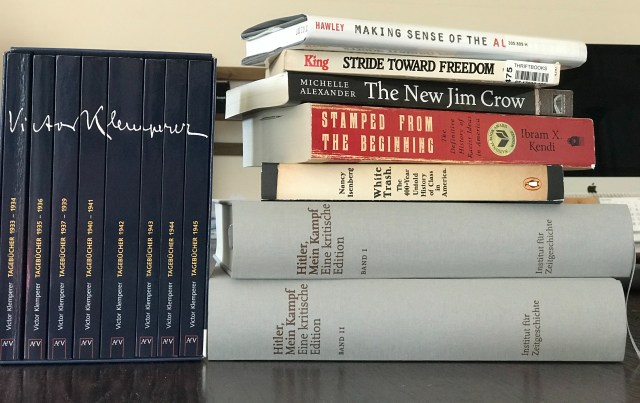
My hands unearthed two huge books from the bottom of a parcel. The unexpected weight of the grey literature almost forced me to drop them. Anxiously, but nonetheless scared, I awaited these books in the last weeks. They would help me to face the demons of our troubled German past as well as my fears for the present and future of our increasingly divided society in the US and around the world.

2017-12-19-12-02-10.jpg

Hitlers „Mein Kampf“ is the ugliest and most hurtful expression of racism and root of crimes against humanity. His evil writing had inspired a whole nation to commence unforeseen brutal actions, bringing death and suffering over generations of Jews and other marginalized people.

Ever since I can remember, the demons of the German past have haunted me. Now I am facing them, trying to explore the history and creation of racism throughout human history. It is this thread I am trying to uncover as part of my doctoral studies.

The critical edition of Hitlers „Mein Kampf“ will be a important and hurtful read as I hope to be a small warning voice in a growing choir of likeminded. Hopefully my research, actions and words will help prevent such crimes ever to happen again.

As I opened the first page of the first volume, my hands were trembling. How will I react to encountering Hitlers ideas for the first time? Which discoveries will haunt my future nightmares? But I knew: Confronting these and other demons, which are rooted in the racial theory of hate and exclusion, is a first important step to hinder tragedies to come. In a politically dense situation like we are facing it in the United States and all around the world, it will be vital to see analogies and name them in order to cast them out.


When stubborn altar candles are witnesses for Christ

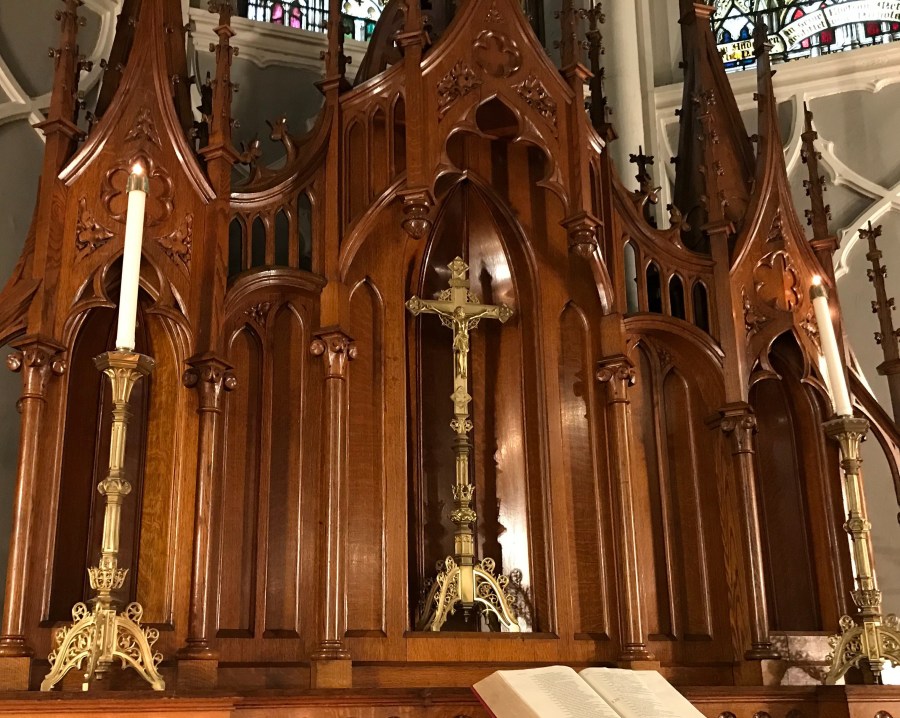
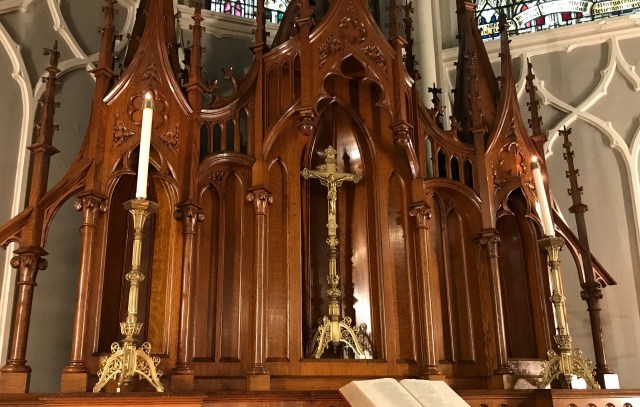
Sunday mornings always follow a beloved ritual: after preparing the sanctuary for the upcoming service, I welcome worshippers one by one as I make my way through the old sanctuary.  And as usual, I could already see the dismay of an elderly lady, who sat at the far right side in one of the last pews, as I moved towards her. After greeting her and exchanging small talk, she pulled me closer to herself. „Pastor!“, she said in a load, booming voice, „haven’t you seen the tall right altar candle? It´s crooked again!“ As every Sunday I apologized to her and then moved quickly through the isle, up five steps to the altar, reaching up high to the stubborn candle and shifting it back into its place.

When I passed the elderly congregant, she nodded in approval and the service could begin. Hymn by hymn, prayer by prayer, reading by reading passed. And slowly but surely, the altar candle as most Sundays made it´s way back into it´s original position. Leaning in a self confident inwardly as if it were pointing towards the cross.

Seldom one Sunday passed without this kind of interactive ritual. After thoroughly looking at the candle holder and applying all kinds of remedies like paper and other material to keep the candle from slipping, I gave in to the stubborn altar candle. Submitting myself to the always present ritual of being adamantly reminded, correcting the candle and watching while it made it´s way back into the old position.

2017-11-05-12-38-101.jpg

It was one weekday afternoon that completely changed my view on this ritual. As I walked through the Sanctuary tired and weary from a incident, the beautiful silence of our church calmed my turbulent thoughts. I sat down in the front pew to find guidance in the daily scripture reading, but instead of giving me relief from the troubles around me, the crucifixion of Jesus Christ was one I surely didn’t want to hear today. I sighed as I read about Jesus way to the cross.

It was the unbelievable ironical words of one of the criminals, who was crucified together with the messiah, which sent shivers down my spine. ‘Are you not the Messiah? Save yourself and us!’  His words seemed to me a symbol of complete resignation to the world, to God and the messiah.

Instead of waiting for a reply from Jesus, the second criminal answered to this grim question: ‘Do you not fear God, since you are under the same sentence of condemnation? And we indeed have been condemned justly, for we are getting what we deserve for our deeds, but this man has done nothing wrong.’ Then he said, ‘Jesus, remember me when you come into your kingdom.’

As the words of the second criminal unfolded in the biblical reading, my eyes went from the bible up to the right altar candle, which was still stubbornly leaning inwards to the cross.

The brave answer and confession of the criminal led to a wonderful eternal perspective as Jesus articulated a promise beyond the criminals guilt: ‘Truly I tell you, today you will be with me in Paradise.’  By confessing his sins, the criminal had completely laid his faith and trust into the hands of God. And it seemed to me as if the candle was not able to do it differently, but to lean towards the cross.

The stubborn altar candle was a silent, but very persistent witness of the crucifixion. Now, Sunday after Sunday, I see the Gospel as it is enacted by these two candles, reminding us to lean on God. For we are not saved by humanly power, but by the grace of the cross through Jesus Christ.


Luk 23:26-39 (NRSV):

Two others also, who were criminals, were led away to be put to death with him. When they came to the place that is called The Skull, they crucified Jesus there with the criminals, one on his right and one on his left. [[ Then Jesus said, ‘Father, forgive them; for they do not know what they are doing.’]] And they cast lots to divide his clothing. And the people stood by, watching; but the leaders scoffed at him, saying, ‘He saved others; let him save himself if he is the Messiah of God, his chosen one!’The soldiers also mocked him, coming up and offering him sour wine, and saying, ‘If you are the King of the Jews, save yourself!’ There was also an inscription over him, ‘This is the King of the Jews.’

One of the criminals who were hanged there kept deriding him and saying, ‘Are you not the Messiah? Save yourself and us!’ But the other rebuked him, saying, ‘Do you not fear God, since you are under the same sentence of condemnation? And we indeed have been condemned justly, for we are getting what we deserve for our deeds, but this man has done nothing wrong.’ Then he said, ‘Jesus, remember me when you come into your kingdom.’ He replied, ‘Truly I tell you, today you will be with me in Paradise.’

Seeking Lutheran Identity in the 21st Century

The High line park near my Church was busy as always on a bright Sunday morning. Many people enjoyed the late fall sun before the icy winter would send cold winds through the New York street canyons.

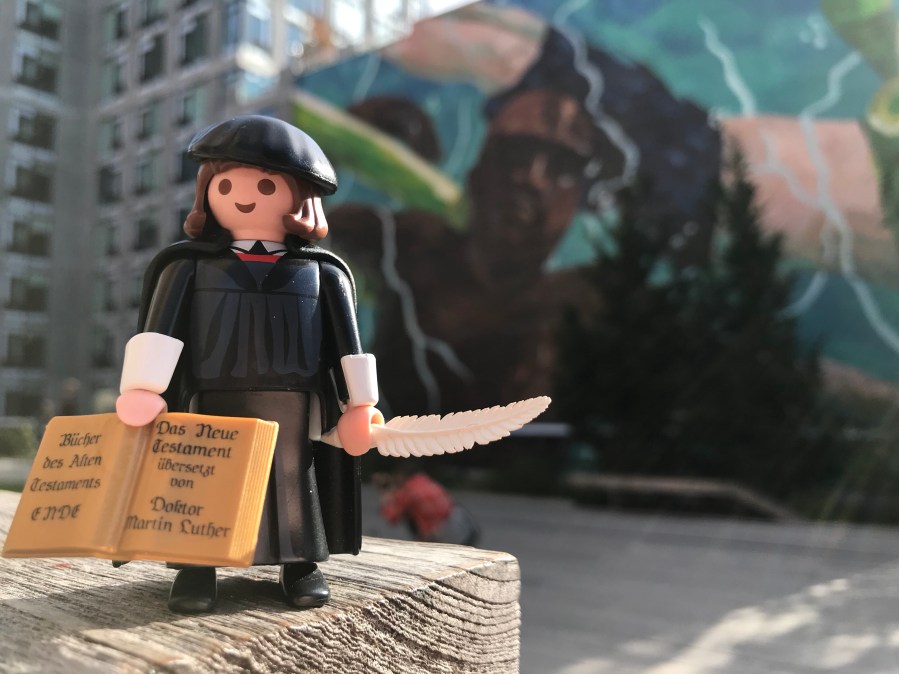
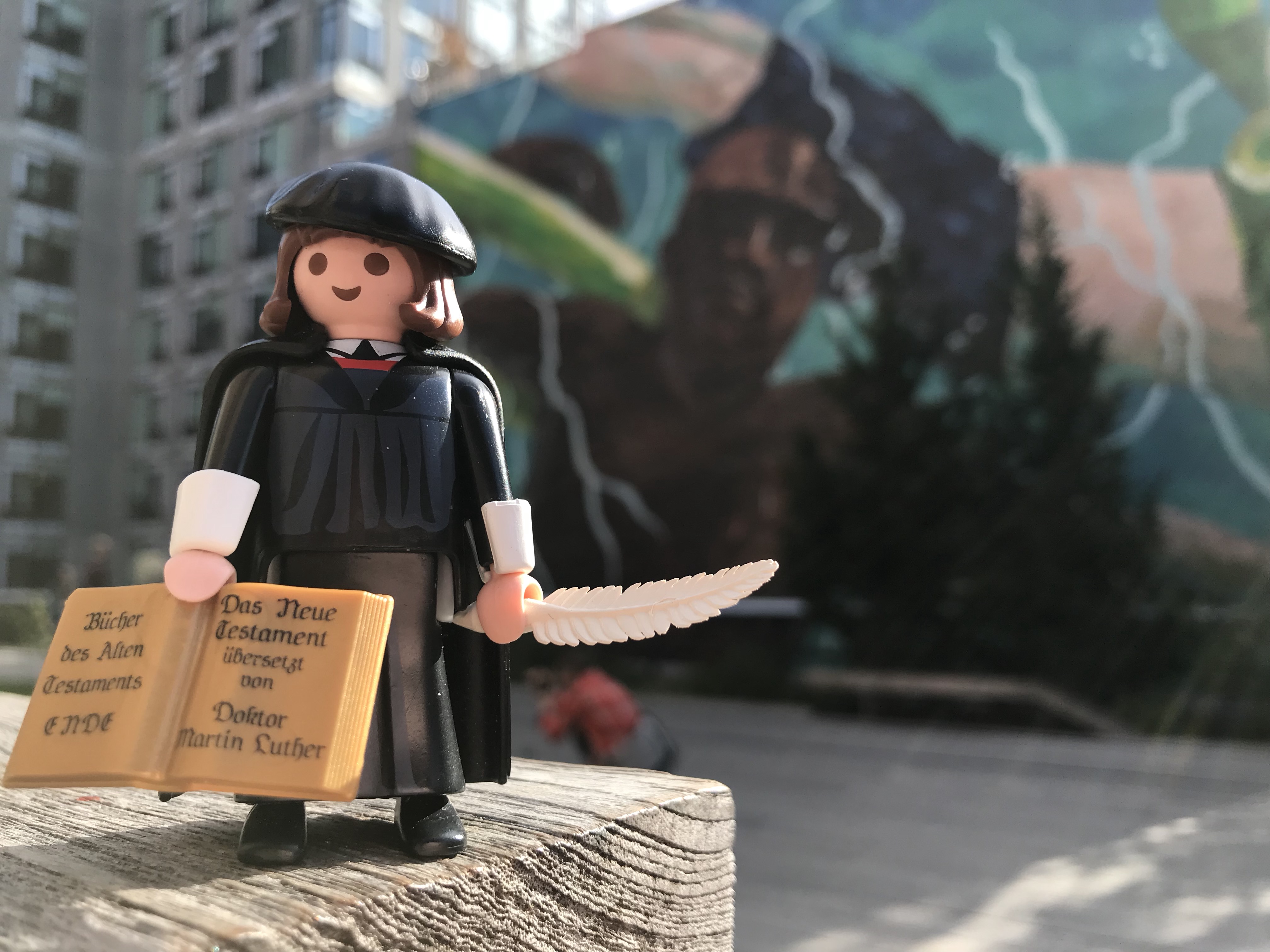
A small scholar in black and white stood in front of a huge graffiti while Henry Taylor´s art work „The floaters“ talked in bright colors about a relaxing day at a pool. The little Playmobil toy set a more earnest tone. Holding a scribes quill in one hand, „Little Luther“ held the Holy Bible in a tight grip as it was glistening in the morning sun. The black letters spoke in a self-confident and brief way of a serious matter that is woven through Martin Luther´s Theology: „The End of the Books of the Old Testament … The New Testament translated by Doctor Martin Luther„. (1)

When I first received the small toy from Germany, I didn’t grasp it´s significance and how deeply embedded into lives this difficult theology can be. Generations of Theologians like Martin Luther and many others saw Judaism coming to an end with Jesus as the Messiah. (2) This misconception of salvation raises difficult questions for a Christian-Jewish dialogue: How can we reconnect even though generations before us have set us so far apart on the basis of these theological misconceptions? How can we rediscover the common ground of the Thora after turning against our Jewish brothers and sisters? What first seemed as neat toy for young and old, is becoming a increasing issue for me as I grow deeper into the Jewish-Christian Dialogue in New York City.

As part of the so called Generation Y, I have been raised with a dominant and strong picture of a perfect reformer, who lead Christianity into freedom from oppression. Who wouldn’t know the different, almost folk like tales, when Martin Luther threw the ink against the wall to scare away the devil? Or when he nailed the 95 thesis to the Church door in Wittenberg?

While emphasizing the German hero Martin Luther, most of the difficult facts have been successfully kept from us during our childhood. And like peeling an onion, layer by layer, the negative sides of the foremost „brilliant“ reformer come to the surface. And this uncovering is causing a identity issue within Lutheranism:

Martin Luther´s strong anti-Judaism, which played a huge inspiring role in leading Nazi-Germany towards the crime of the Holocaust. His words might have been part of a larger societal crime, but neither his grief for the death of his daughter nor his senility can ever explain his false theological opinions. Or his political misconceptions, where Luther sacrificed the peasants to their oppressors in order to endure in the power struggles of Church, Lordship and the normal people.

Layer after layer the Lutheran Identity is challenged. We are now facing a long overdue and cleansing identity crisis within Lutheranism. The „great hero“ of the Reformation is demasked as failing and sinful person. His own words may be a consolation to us in the midst of transformation: we all are sinners and saints.

The 500rd celebration of the Reformation might be the perfect time to reflect and to uncover the „real“ Martin Luther learning from his theological brilliance AND his terrible theological failures. A great opportunity might be at hand to bring Luthers core discovery to its true significance: Transforming Lutheranism as a means of hope beyond failure, grace beyond sin.


(1) Playmobil has altered its 1st edition, deleting the „Ende“ due to the difficult theological implication of the writing.

(2) Paul in contrast states that the Jews are saved – see Rom 11.

A Subway „Halleluja“

My tired feet dragged me step by step to the shuttle train. Same procedure as ever for a pastor, living and working at two ends of her congregation. A normal New York story of long commutes, short nights and many challenges a large city and ministry brings.

While I swam with the faceless masses of fellow commuters my mind raced like mad. Outwardly calm, words sharp like razor knives echoed in my mind. What a irony while we were celebrating International Day of Peace in New York and all around the world! There are so many things wrong in our world – in every day life! I lamented and lamented in my thoughts while the book case in my hand got increasingly heavier.

As I dragged my way down the grey steps a familiar tune played by a trombone filled the stuffy subway air: Leonard Cohen´s „Halleluja“ woke me up from my nightmarish thoughts of one-way-streets and dead ends. The song was like balm on my weary soul. It seemed as if I was told by God that it would be alright in one way or the other sometime.

I had to think of Leonard Cohen´s words when he once was approached by John McKenna in a interview about his famous song „Hallelujah“:

„Finally there’s no conflict between things, finally everything is reconciled but not where we live. This world is full of conflicts and full of things that cannot be reconciled but there are moments when we can transcend the dualistic system and reconcile and embrace the whole mess and that’s what I mean by Hallelujah. That regardless of what the impossibility of the situation is, there is a moment when you open your mouth and you throw open your arms and you embrace the thing and you just say ‚Hallelujah! Blessed is the name.‘ And you can’t reconcile it in any other way except in that position of total surrender, total affirmation. […]

That’s what it’s all about. It says that none of this – you’re not going to be able to work this thing out – you’re not going to be able to set – this realm does not admit to revolution – there’s no solution to this mess. The only moment that you can live here comfortably in these absolutely irreconcilable conflicts is in this moment when you embrace it all and you say ‚Look, I don’t understand a fucking thing at all – Hallelujah! That’s the only moment that we live here fully as human beings.“ (1)

Leonhard Cohen´s song escorted me into the new hectic day in busy New York. Not everything would be fine and lots of things would stay a hurtful mystery to me. But in the mean time I would praise God. In the subway and beyond.


(https://www.leonardcohenfiles.com/rte.html )

False messiahs, votes, and hopes for the future

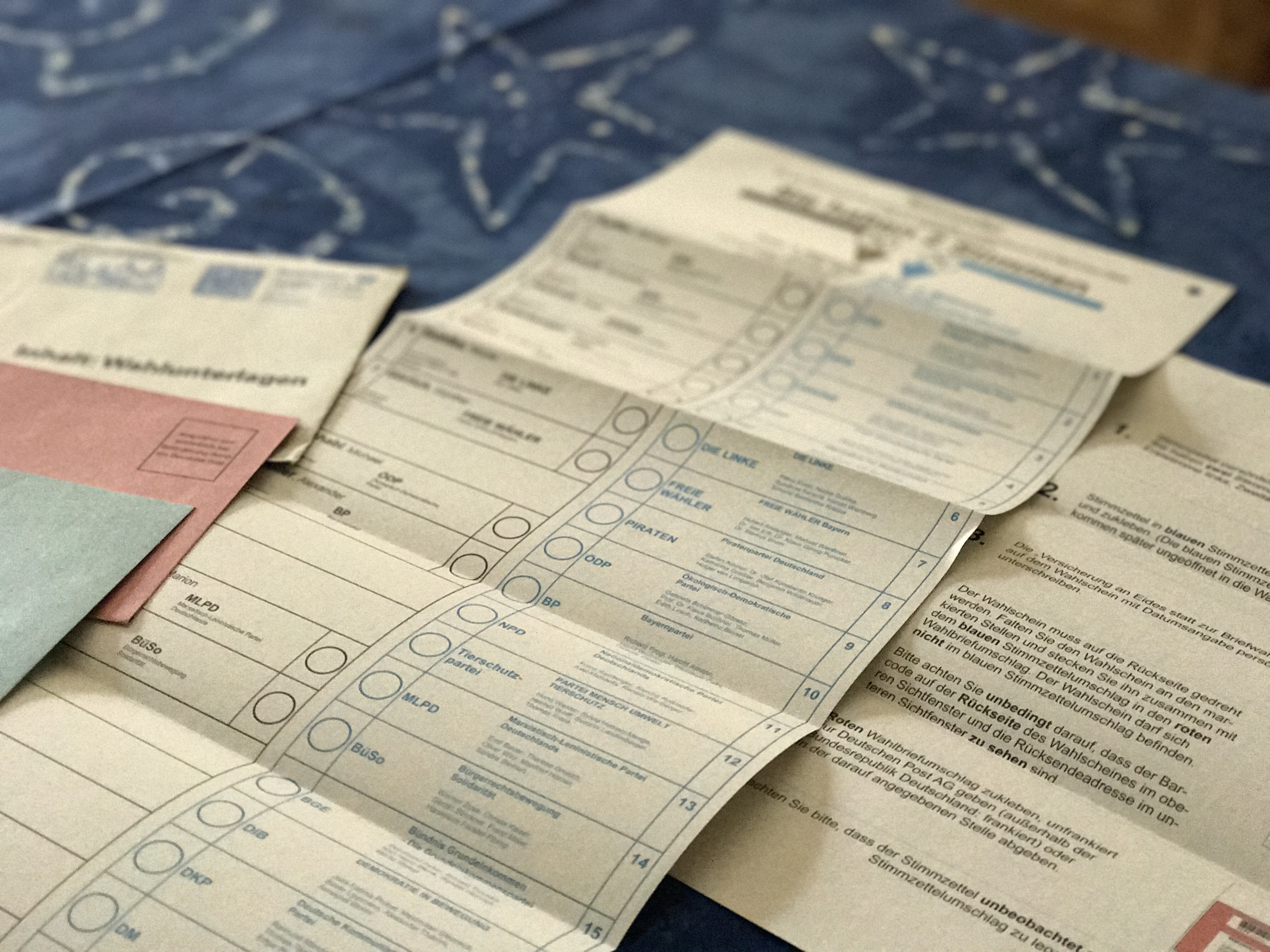
A sigh of relief passed my lips as I opened my absentee ballot that had just come with our daily mail. It had been some journey to exercise the rights of my German citizenship: After applying in April the ballot finally arrived two weeks before the election. As I opened the grey envelope, perfect German structure greeted me while my mind wandered of to the consequences of my vote and that of 82 Million German citizens. Even though nobody really expected a political messiah, many of those near to me set their hopes on the main stream parties. And I must admit, the rather uneventful political campaign without any major scandals had a consoling effect on me. But these quiet and intellectual campaign trails have not always been part of Germany´s political makeup.

When Hitler headed for being reelected in November 1933 a incredibly accurate planned show was orchestrated by Hitlers Propaganda minister Goebbels. In many ways it had particularly similar elements of a boastful and arrogant attitude, which was exposed during the last US-American campaign for the oval office. The loud outward appearance was even called by some „American style“. Victor Klemperer diary entry from Nov 11, 1933 is a shocking and insightful reminder of this time:

„The excessive propaganda for the “ Yes“. On every business car, postal car and bicycle , at every house and shop window, on wide banners stretched across the street – everywhere slogans by Hitler and always „yes“ for peace. It is the most unbelievable of all hypocrisies. We want more soldiers to make the army to the militia and to blend with the million of SA [Sturmabteilung]. Parades and choruses until into the night, loudspeakers on the streets, music cars (with on the top mounted radios), cars like trams.

Yesterday from thirteen to two o’clock the „festive hour“. „In the thirteenth hour Adolf Hitler comes to the workers.“ Perfect the language of the Gospel. The Redeemer comes to the poor. And in addition the America-appearance. The sirens‘ haul, the minute of stillness […] A highly skilful, calmly spoken report on the disposition by Goebbels, and then about forty minutes of Hitler. A generally hoarse, overwhelmed, excited voice, wide passages in the vindictive tone of the preaching sectarian. Content: I know no intellectuals, citizens, proletarians – only the people. Why have millions of my enemies remained in the country? The emigrants are „rascals“ like the brothers Rasser. And a few hundred thousand rootless international – interjection: „Jews!“ – want to oppose millions of people. I only want peace, I have risen from the low people, I do not want anything for myself, I have three and a half years‘ full power and do not need a title. You must say yes for your sake. […] The man [Hitler] is a excessive enthusiast. And he hasn’t learned anything.“ (1)

As I started to fill out my absentee ballot, I couldn’t get my mind of the present difference of politics in both countries. Here was I in one of the greatest nations in the world casting my vote for the highest office in Germany – and in some ways things have been tossed upside down. My fear of seeing this nightmare happen again intensified significantly in the last weeks when hearing about the rise of right winged parties in the country of my upbringing. We may not have the choice of electing a „political messiah“ – and I am very honest: I do not hope, we will ever be blinded and lulled into disaster by a crazy and powerful politician! But by exersizing the rights of my citizenship in a democratic way, I will be able to be a small drop making a difference against any right winged tendencies.


(1) Victor Klemperer, Tagebücher (1033-1934), p. 67-68. Translation (MG)

In hot waters…

The tea cup slowly filled with hot, boiling water as the small silver frog held tightly on to the rim. What first seemed such a normal activity of filling hot water into a cup with a animal shaped tea egg, quickly evoked unforeseen associations in my news shaken mind. I could almost feel the hot water of the cup surrounding myself as the news trickled in about the Pardon of the former Sheriff and White Supremacist Joe Arpaio.

Just minutes ago I had begun reading Victor Klemperer´s diary. A stunning testimony of the terrible events leading Germany and the whole of the world into a humanitarian disaster. As I reached his entry from March 14, 1933, Victor Klemperer mentioned different happenings in a quick succession. The first one evoked a cold shiver running down my spine as I simultaneously heard the current news evolve.

„On the order of the Reichskanzler the five people, who were sentenced during summer by the special court in Beuthen for killing of Polish insurgent convict have been pardoned.“ (1)

For me as a German pastor it is like deeply hurtful déjà-vu , reminding me of the beginning of a disaster evoked by my nation upon others and mostly the powerless and marginalized. Over 6 million Jews and many uncountable others were murdered through the fascist regime of Adolf Hitler and the Nazis. The above mentioned „Potempa-Murder“ by five SA-men and its sentencing , which took place in August 1932 (2) and the pardon by the newly empowered Reichskanzler Hitler was just the beginning of a brutal and systematic change to a system of fear, oppression and death. It was the first step, even though it was announced as a „legal and proper act“, that may be seen as the official recognisable dismantling of the parliamentarian democracy. More and bolder steps would follow very soon.

As I pulled out the small frog shaped tea egg, it lay hot and steaming in my hand. I quickly tossed it into the kitchen sink as I eased my burning skin with cold water. If only mankind would learn from their broken past that sometimes leaves aching burns and deep scars on society. I could only hope that the testimony of Victor Klemperer and others, who give us through their writings a precious time machine into a broken and terrible past, may be a warning sign for us as the presence and the future is unfolding.

https://youtu.be/qZ5twOslkGE

_________________________________________________________

(1) Victor Klemperer: Tagebücher, 1933-1934, Berlin 31999, p. 11. (Translation: MG)

(2) http://www.bundesarchiv.de/aktenreichskanzlei/1919-1933/1000/vpa/vpa1p/kap1_2/para2_123.html;jsessionid=56F760C0770BFEBB61A62667DB9F769D?highlight=true&search=Luetgebrune&stemming=false&pnd=&start=&end=&field=all

Free to love another

Loud pop music greeted us as we entered a small Irish pub in downtown Washington, D. C. Four women were on the seek for some good food and a place to enjoy time with one another. It seemed oddly fitting for us to choose exactly this location as a diverse group of women, who found friendship through a shared passion – the passion to proclaim the commandment to love neighbor and self in a public way as Jesus had asked his disciples.

The doctorate „Public Engagement“ at the Wesley Theological Seminar (Washington, D.C.) had made our lives paths cross in an unexpected way. Maybe without Gods providence we would have never met one another. The communities we come from are very different and even if it hurts, to write this, in the United States these „social bubbles“ might not interact as eagerly as one might wish.

But God has provided us a beautiful friendship, binding together in love and respect a Korean-American Methodist Minister, a African-American Church of Nazarene Minister, a Latina-American Methodist Minister, and a German Lutheran Pastor. It is this friendship that was formed early on in the course, which gave me the greatest lesson I could ever learn: that we are free to love another. We don’t need to stretch ourselves out of shape in order to love the other person, but if I accept my neighbor in his neighborliness I am able to find myself as a human being God the creator has made. By hearing their story, sharing our lives with one another, crying, celebrating, and just being there for one another. It is such a gift and privilege, because I can be, who I am. A German Lutheran, who carries the burden of the troublesome German past, and tries in her humanly ways to influence the the present and future driven by Gods love.

2017-05-17 18.36.18-1

It is in Howard Thurman I have found an exceptional theologian and mystic, who was able to put the experience I am making into beautiful words (please note that when he writes about male, I am freely contacting female as well!):

„The religious experience as I have known it seems to swing wide the door, not merely into Life but into lives. I am confident that my own call to the religious vocation cannot be separated from slowly emerging disclosure that my religious experience makes it possible for me to experience myself as a human being and thus keep a very real psychological distance between myself and the hostilities of my environment. Through the years it has driven me more and more to seek to make as a normal part of my relations with men the experiencing of them as human beings. When this happens love has essential materials with which to work. And contrary to the general religious teaching, men would not need to stretch themselves out of shape in order to love. On the contrary, a man comes into possession of himself more completely when he is free to love another.“

(Howard Thurman, The Luminous Darkness, New York 1965, p. 111.)

„Message in a book“

Soft and mild wind helped to ease the hot summer air. I was sitting on our patio listening to the song of cicadas as I opened my newest book purchase: A 40-Day Journey with Howard Thurman. With the school break and business slowing down even in New York it was the perfect time to start a spiritual journey.

There could have not been a better person than Howard Thurman to start with as a guide. Since a few months studying as a German Lutheran at Wesley Theological Seminary for my D. Min. I am increasingly emerged into the complexity of Racism and White Supremacy in the United States. A problem, which I growing up in Germany was not aware in its depth and brutality. Thurman, as I quickly discovered, offers a way to combine faith and social action, religion and politics by giving examples from his own upbringing and situation in a deeply divided south.

As I opened the first page of the "used book in good condition", as the seller had described it, a small handwritten note fell into my lap. This was not a "message in a bottle", but a "message in a book", that was carried to me on the waves of transport through the American Postal Service.

2017-08-11 11.42.02

With awe I read the anonymous penciled down message. The handwriting flowing over the page as if the words were spilled deeply out of a broken heart:

"When I dropped out of college, for weeks I didn't tell my parents. I just would be told I was a failure. I didn't want to disappoint my parents, my grandparents and my extended family. I don't recall calling on God to help me through this dark time. I probably felt I deserved all of it. Feelings and guilt and shame for not trying harder and sticking with it. I had quickly shed my faith after leaving home for college and avoided asking for guidance and help from God. I had better things to do than pray, " The last word was erased. Then my contact to the anonymous writer broke off completely.

My heart immediately burned for this stranger, who had experienced so much troubles. Was he able to make his way into a better and positive life? And more importantly: Was he able to find his way back into Gods loving arms? I would never know.

As our brief journey ended with the last hastily pencilled word, mine would just begin. The writings of Thurman I read up to now are an eye opener to understand the brutal make-up of a country I love since childhood. A country deeper divided by racism and skin color than I ever could imagine in my deepest nightmares. As I go on a 40-Day journey with Thurman to discover faith and love beyond color and race, my prayers will accompany the writer of this message in my book. May God show him the beauty in his broken-made-beautiful life.


A state of grace

As I woke up early in the morning, the smiling faces of my kids greeted me. They had quietly decorated my bed stand with gifts and cards for mothers day. Now they jumped in my bed, hugging and kissing me with excitement.

Mothers day is always a humbling day for me. Even though it really feels good to be spoilt on that day, it is more about all the love, which freely from any thought of retribution comes back to me. Just out of love. For free. Without ever asking for a payback. A state of beautiful grace, that I was able to experience.

A so much larger gift of grace, that changed the religious world in a unforeseen way, came to Martin Luther, when he discovered that he did not have to earn it as the Roman catholic church thought it, but was gifted for free. For God through Jesus Christ loves humans because they are, not for what they do. Martin Luther named it „sola gratia“.

Grace is Gods undeserved favor toward sinners. It is Gods free gift towards us, but Jesus Christ paid a huge price on the cross to set us free. A precious gift that makes me stand up every time I fall and stumble over my own brokenness.

A precious state of grace.

A voice crying out in the wilderness.

The door of the old safe opened with a disapproving squeak. As it made space for its precious and historical content my eyes fell on the inscription above: “Immigration Bank of New York 1899”. One of many signs of the ever-present immigration history of the 175-year-old German Lutheran congregation.

I extracted from underneath piles of old and new records, check books and documents an old Bible from 1931. Its book wrapper was torn and used. Like a precious arc containing a memory from a time long past. The Bible was dedicated to the Church of St. Paul´s for its 90th anniversary in September 1931, and signed by the President of Germany, Paul von Hindenburg. He was a nationalistic Lutheran binding politics and Church together in a very active manner.

Back then nobody even had the premonition of the disaster, which would haunt Germany, Europe, and the whole of the world. The prominent historian Wolfram Pyta argues in the contrary to other researchers that Paul von Hindenburg as an 84-year old President very actively chose Adolf Hitler as the legitimate heir of the German empire, and by being a bystander helped Hitler to become a dictator, who would implement successfully Nationalistic and extreme thoughts in the German public mind. [i] Most major institutions and – a hurtful fact for Protestants – many large Church bodies embraced Hitler and his disastrous thoughts. My Lutheran Home Church in Bavaria endorsed him eagerly. Bishops supported him. Clergy had to preach according to Hitler´s writings with a watered-down gospel. Supporting Hitler was not just an ideological decision, but one evoked by money and influence. Proclaiming the true Gospel of Jesus Christ in its whole strength like a voice of one crying out in the wilderness of a political dictatorship was not only dangerous – it bore the risk of losing all your wealth, privileges, and influence.

The privilege of receiving Church taxes with beginning of the Nazi dictatorship was fairly new: after fighting for compensation due to the “Principal Decree of the Imperial Deputation” in 1803, when the Churches lost huge stretches of land, buildings and possessions left of the Rhine river, a compensation was implemented. Church tax was anchored into the Weimar Constitution in 1919. [ii] The financial future of the Church was secured with a stable income, and in addition to that pastors become public servants. But it came at a high cost. It meant collaborating with the State in structures and content. A connection, which led to the disaster of the “German Christians” as an instrument of the Nazi tyranny.

Holding the old “Hindenburg-Bible” as an artefact in my own hands, immediately evokes very ambivalent thoughts about the present political situation in the United States, and by acknowledging it as the prominent leading nation for the whole of the world. A quiet admonisher of a disaster bestowed on all of humanity, which haunted our world like never seen before.

After Germany was freed from the Nazi tyranny the Protestant Churches went into a deep crisis. The institutions had lost most of the trust by being an instrument of Hitler´s deadly machinery. To regain this trust massive measures were taken, learning from the words of the Confessing Church with its broadly known Barmen Declaration. The Church had to be deeply separated from the State, only accountable to God´s word. Due to the financials struggles they couldn’t survive without the income through taxes. To ensure freedom from political parties and structures a freedom in speech for Clergy based on the Gospel and the Confessions was implemented. This lead to a double freedom for clergy and the Church itself: Clergy didn’t depend on the income of the congregation and wouldn’t need to preach according to the members to receive a pay. Furthermore, Clergy were only responsible to the Holy Scriptures and the Confessions as long as they as citizens didn’t violate the civil rights of Germany. [iii]

When growing up in a Lutheran environment in Germany, and then working as a pastor in the above described system, I always took both for granted: Being able and even expected to proclaim the Gospel unadorned. Never having to fear about not receive a pay or stipend as long as the words kept within the above-mentioned boundaries, meant freedom from the opinion of parishioners and committees. And even though I was a public servant, I never had given in to a possibly State proclaimed content.

As I left Germany to minister to a small German Lutheran Congregation in New York, which governs itself according to American legislation, not only meant a crash course in “American lifestyle”, but a huge learning curve about the expected role of a pastor as the proclaimer of the Gospel in a certain context. Now, with the new administration voices are becoming louder, pressuring me like many other colleagues to be silent about any political reference. Most folk will eagerly quote from the State offered tax exemption status through 501(c)(3), which after the opinion of some forbids any speech with political references. What they forget, is that the Gospel was and still is a highly political message. Being a tax-exempt institution does not forbid to speak about the current political situation – it does forbid talking concretely about a certain party or person. Rev. Dr. Leah Schade, who is an Assistant Professor of Preaching and Worship at Lexington Theological Seminary, is trying to find and outline solutions for preaching controversial issues in the context of American Churches. A very important issue, which will be the turning point of the role of Churches in America and how deeply they will stand on the ground of the Gospel.

Coming from Germany, and experiencing my second ministry abroad, I think the Church can only live up to its calling, when it actively embraces the role of John, the Baptist as the voice of one crying out in the wilderness. If it is silenced by money, being afraid of losing its privileges, history is repeated. Germany has been there. Unbelievably many have suffered. And the Gospel has been broken by those, who should have safeguarded it.

These are the challenges American Churches like the ELCA are now facing. Will it stay silent in the midst of a cancerous and dangerous political system? It may only be able to live up to its calling through a very bold step: By changing its funding, freeing itself from a covered up strong bond to the State. One solution could be a centralized funding of minister stipends, as it can be found in the Reformed Church of Scotland. Working as an Island pastor a few years ago due to a European ecumenical partnership, I was part of a in Scotland established equal pay system. All congregations would pay according to a certain key to the central offices, ensuring the stipend of a pastor no matter where he or she might work. This ensured, that pastors were free from the income of their congregation, and that they could even afford to minister in very remote places – bringing the Gospel, where maybe otherwise very extreme opinions might develop. Just imagine, what such a system could do in the United States… With pastors being able to freely proclaim the Gospel, even in areas, where the political atmosphere is dangerous or opposing to the Gospel!

But as a German pastor working in the rough American wilderness of New York City I might just be a lonely and urging voice, devoted to remember others of the crimes and failure our German nation. Crying out for justice and peace: “Make straight the way of the Lord!”

__________________________________________________________________________________________

More information about the work of Leah Jacobs Schade: https://thepurplezone.net

[i] Wolfram Pyta: Hindenburg. Herrschaft zwischen Hohenzollern und Hitler, München, September 2007.

[ii] Article 137, paragraph 6: „Religious communities, which are cooperations under the public law, are entitled, on the basis of civic tax lists according to the measure of federal state law, to raise taxes. [Translation: Miriam Groß] Original: „Die Religionsgesellschaften, welche Körperschaften des öffentlichen Rechtes sind, sind berechtigt, auf Grund der bürgerlichen Steuerlisten nach Maßgabe der landesrechtlichen Bestimmungen Steuern zu erheben.“

[iii] For those fluent in German: Pfarrerdienstgesetz der EKD § 24 Absätze 2 und 3: “ ( 2 ) Pfarrerinnen und Pfarrer sind in Gestaltung und Inhalt ihrer Verkündigung frei und nur an die Verpflichtungen aus der Ordination nach § 3 Absatz 2 und an die Ordnungen ihrer Kirche gebunden.

( 3 ) 1 Pfarrerinnen und Pfarrer haben in ihrem dienstlichen und außerdienstlichen Verhalten erkennen zu lassen, dass sie dem anvertrauten Amt verpflichtet sind und dieses sie an die ganze Gemeinde weist. 2 Sie berücksichtigen in ihrem Dienst die Vielfalt der Handlungsfelder und Erscheinungsformen, in denen sich der Auftrag der Kirche konkretisiert.

34: „Pfarrerinnen und Pfarrer haben durch ihren Dienst wie auch als Bürgerinnen und Bürger Anteil am öffentlichen Leben. 2 Auch wenn sie sich politisch betätigen, müssen sie erkennen lassen, dass das anvertraute Amt sie an alle Gemeindeglieder weist und mit der ganzen Kirche verbindet. 3 Sie haben die Grenzen zu beachten, die sich hieraus für Art und Maß ihres politischen Handelns ergeben.“