this morning I stood at the sink in my kitchen, sleeves pushed up, hands moving through what felt like mountains of dishes — plates stacked too high, cups gathered from different corners of yesterday, traces of meals and conversations clinging stubbornly to porcelain and glass. It looked as if chaos had passed through quietly during the night and left its mark without asking permission, and now it waited to be tended, piece by piece.
Behind me, a small speaker connected to my phone filled the room with the steady murmur of German radio news. I wasn’t listening closely at first. The voice blended into the sound of running water and clinking dishes, almost background noise. And yet certain words surfaced and stayed — America, Minnesota, a demonstration, a man in his thirties who had died, another name mentioned briefly. The tone was restrained, careful, but something heavy settled into the room all the same, as if the news had slipped into the spaces between my movements and my breath.
I kept washing, aware of how these stories — distant and mediated — traveling across oceans and arriving in ordinary European Sunday mornings, finding their way into kitchens like mine, into moments that would otherwise remain small and contained.
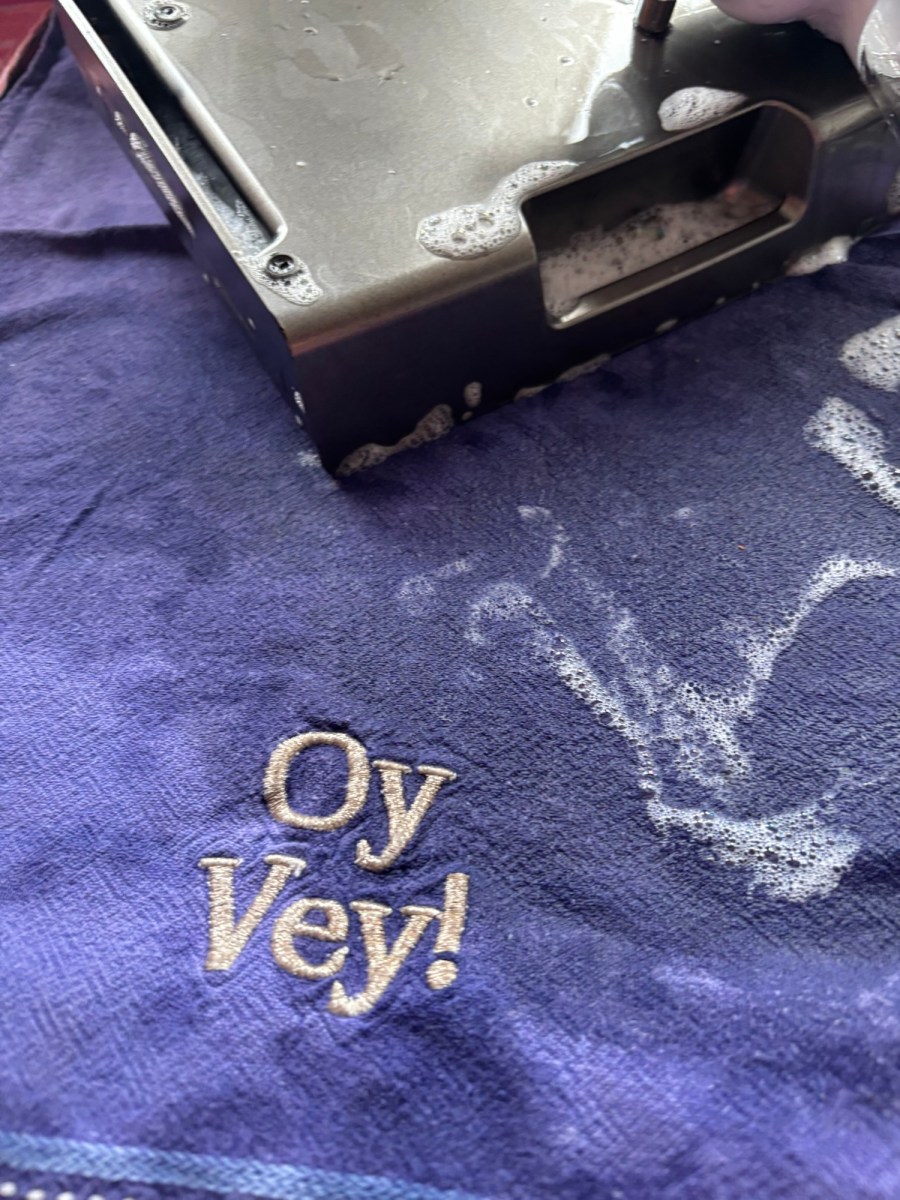
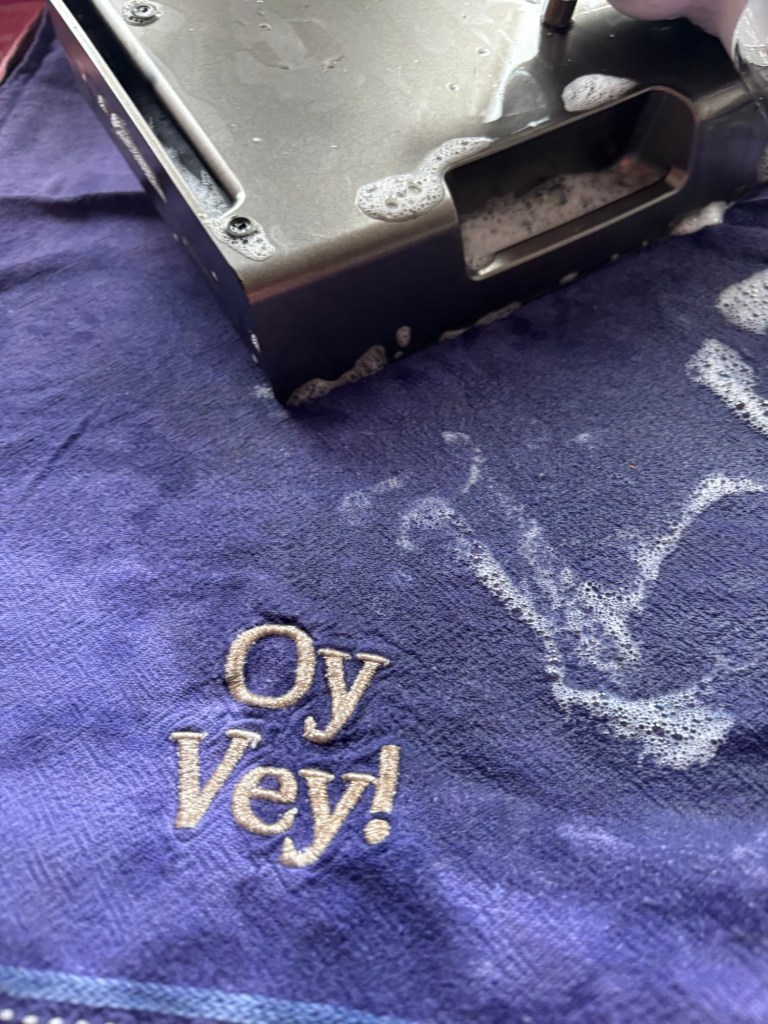
When I turned to dry my hands, I reached for a dish towel lying crumpled underneath some dishes on the counter. I bought it back when I still lived near you, at a time when certain words could still be worn lightly, almost playfully. The towel was already damp, heavy with water and the traces of its work, no longer able to dry anything else, waiting instead to be washed. The fabric has softened over the years, its edges slightly frayed now, and across it runs that familiar word, printed boldly:
Oy.
Back then, it felt like a wink — cultural shorthand, shared humor woven into cotton. Today it did not wink back. Standing there with the radio murmuring behind me, it sounded different. Heavier. Not because the word had changed, but because the world had.
In the Torah and the prophets, Oy is never decoration. It is the sound a human voice makes when it discovers, too late and too clearly, that something holy has been stepped across — and that there is no safe distance left.
Isaiah 6:5 אוֹי־לִי כִּי־נִדְמֵיתִי Oy-li ki nidmeiti
“And I said: Woe is me! I am lost, for I am a man of unclean lips, and I live among a people of unclean lips; yet my eyes have seen the King, the LORD of hosts!” (NRSV)
Here, Oy marks the moment of radical self-recognition, when proximity to holiness does not elevate but exposes, revealing how entangled human life is with what it tolerates and permits.
The Psalms carry a quieter version of the same cry — not sudden shock, but the ache of prolonged moral displacement:
Psalm 120:5 אוֹיָה לִּי כִּי־גַרְתִּי מֶשֶׁךְ Oyá li ki-garti Meshech
“Woe is me, that I am an alien in Meshech, that I must live among the tents of Kedar.” (NRSV)
This Oy belongs to those who remain committed to peace while living among systems that normalize force and disregard the vulnerable.
The rabbis did not soften this cry. They allowed it to mature into responsibility. In the Talmud it becomes communal, spoken by those who know that accountability cannot be deferred:
Berakhot 28b אוֹי לָנוּ מִיּוֹם הַדִּין Oy lanu mi-yom ha-din “Woe to us because of the Day of Judgment.”
And then, one evening, I discovered a passage that has not let go of me since. In a rabbinic reflection on the destruction of the Temple, even God is imagined as crying out:
Berakhot 3a אוֹי לִי שֶׁהֶחֱרַבְתִּי אֶת בֵּיתִי וְשֶׁשָּׂרַפְתִּי אֶת הֵיכָלִי וְהִגְלֵיתִי אֶת בָּנַי בֵּין הָאוּמּוֹת Oy li she-hechravti et beiti, ve-she-sarafti et heichali, ve-higleiti et banai bein ha-umot
“Woe to me that I have destroyed my house, burned my sanctuary, and exiled my children among the nations.”
What struck me here was not only the audacity of placing lament in God’s mouth, but the theology beneath it: power that does not absolve itself, but grieves what it has allowed to be lost.
When Jesus speaks centuries later, he does so entirely within this Jewish tradition. His sharpest words are framed as laments, not as insults, and at the edge of life he reaches for the oldest prayer he knows:
Mark 15:34 / Psalm 22:1 אֵלִי אֵלִי לָמָה עֲזַבְתָּנִי Eli, Eli, lama azavtani
“My God, my God, why have you forsaken me?” (NRSV)
Here, Oy is no longer spoken. It has become breath itself — prayer offered from abandonment without severing relationship.
The twentieth century stripped language even further. Paul Celan, born in 1920 in Czernowitz, a German-speaking Jew whose parents were murdered in the Shoah, knew that words themselves had been burned. Todesfuge does not explain; it repeats. It sings where speech breaks. It does not cry Oy — it inhabits it.
And now the word returns to me, standing in my kitchen in Germany, a damp towel waiting to be washed, the radio already moving on to the next item. Not as irony. Not as nostalgia. But as lament.
Oy — for lives taken in the service of power. Oy — for hands that rise because they are authorized to rise. Oy — for the quiet corrosion of human dignity.
It is an Oy for America, whose promises feel stretched thin.
An Oy for Germany, whose history obliges us to hear these echoes more clearly than most.
An Oy for a world that keeps mistaking dominance for order and control for safety.
I place the towel into the wash. The dishes are done. The room grows quiet. But the sound remains — not loud, not theatrical, just present.
Oy.
A sigh that does not accuse, but remembers. A breath that asks whether we are still willing to cleanse what clings to us — and whether we will choose, again and again, to become hands that mend rather than hands that take.
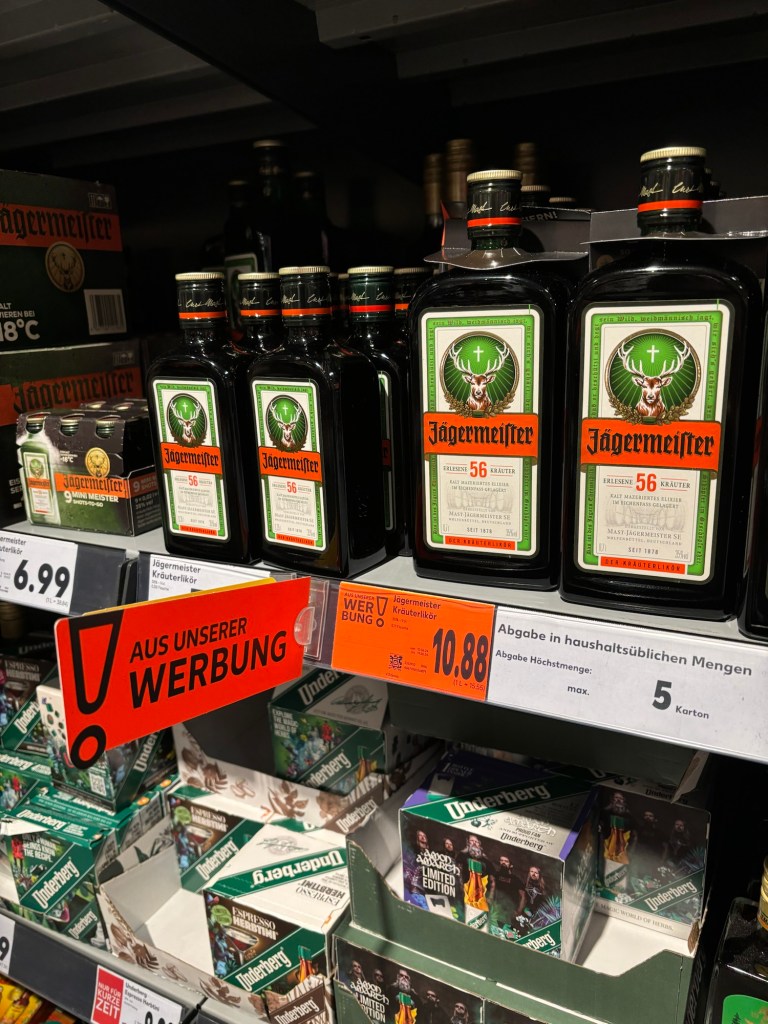
KNÜLLER-PREIS. BARGAIN PRICE. Bold red letters on pure white. I stared at the paper advertisement as I ran through the offers at our local discounter. It was the week after the European election. We had suspected that there would be a shift to the extreme right (and maybe even left?), but the shift hurt in ways I can’t really put into words.
Numerous gave their precious votes, because the campaign pledges of the extreme parties seemed such a bargain. KNÜLLER-PREIS. BARGAIN PRICE. They would secure their wishes. But I wouldn’t be so sure – they numbed voters by catchy messages, cheap promises and easy answers. In many ways the history of the German herbal liquor „Jägermeister“ and the campaign strategy of the extremist parties fit very well. Both intoxicate. Both have roots in right-winged hatred.
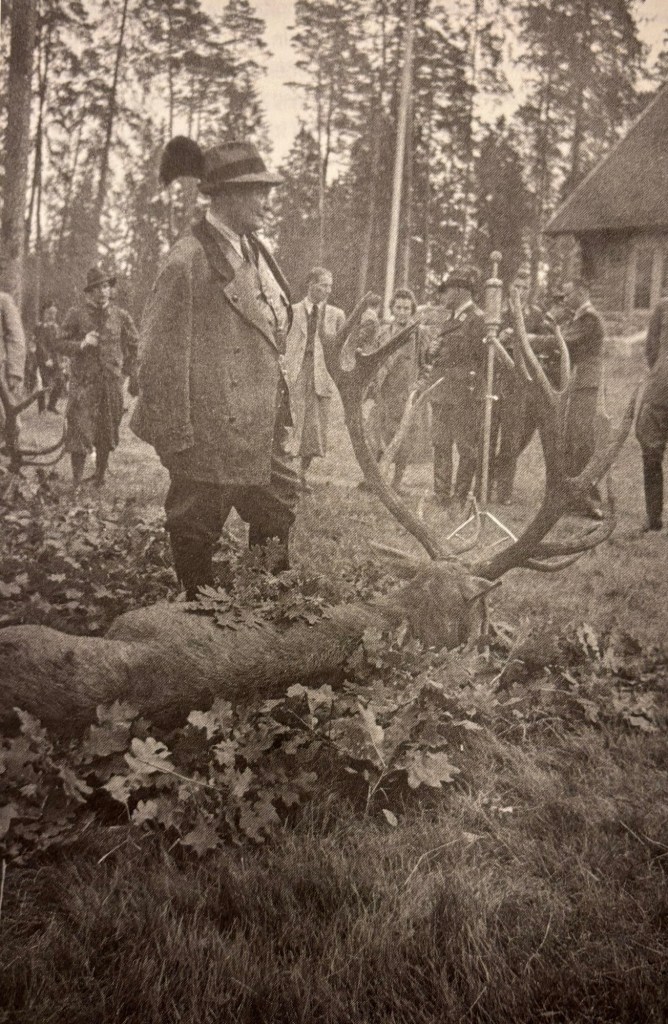
The label on the German herbal liquor „Jägermeister“ states 1878, but this date is the founding of the original vinegar factory. Curt Mast, son of the company’s founder, shifted the production away from vinegar to spirits and wines. In 1934 he invented the famous liquor. It was the year, in which Hermann Göring was nominated „Reichsjägermeister“ to be the highest „professional hunter“ in Germany – the term Jägermeister hadn’t been used for centuries. Just one year later, Curt Mast introduced his new herbal liquor and named it after Göring, whom he knew well. The design of the bottle was held in green with a deer head and cross. There are photographies of Hermann Göring as Reichsjägermeister with his prey showing huge deer antlers. Many therefore even called the herbal liquor „Göring-Schnaps“. (1)
Hans-Jörg and Gisela Wohlfromm: „Und morgen gibt es Hitlerwetter!“ Alltägliches und Kurioses aus dem Dritten Reich, p. 168.
It is this historic background that makes me nervous as extremism seems to creep into our society disguised as a bargain. KNÜLLER-PREIS. BARGAIN PRICE. Now it is on the shelves of democratic elections like this Schnaps is in my local supermarket. But we must be warned of how these extremists operate: they use symbols present in everyday life and can source each other with their right (or left) extremist ideology. Popular songs, pictures and numbers („88“) seem harmless, but have a hidden code extremists spot and identify. Dog whistling is such a dangerous mechanism. Nonetheless, it is just the first step. As soon as they have established themselves as the largest offer on the shelves of democracy we will be doomed.
A small lesson of history on a supermarket shelf.
I suddenly felt sick as I passed the display of the herbal liquor on my way to the cash register. Small, medium and large quantities – the latter only in a maximum quantity of five bottles. We should be vigilant that our democracy will not become a KNÜLLER-PREIS, a BARGAIN PRICE for extremists.
(1) see Hans-Jörg and Gisela Wohlfromm: „Und morgen gibt es Hitlerwetter!“ Alltägliches und Kurioses aus dem Dritten Reich, p. 167.
D-Day and the European election – a covenant for democracy
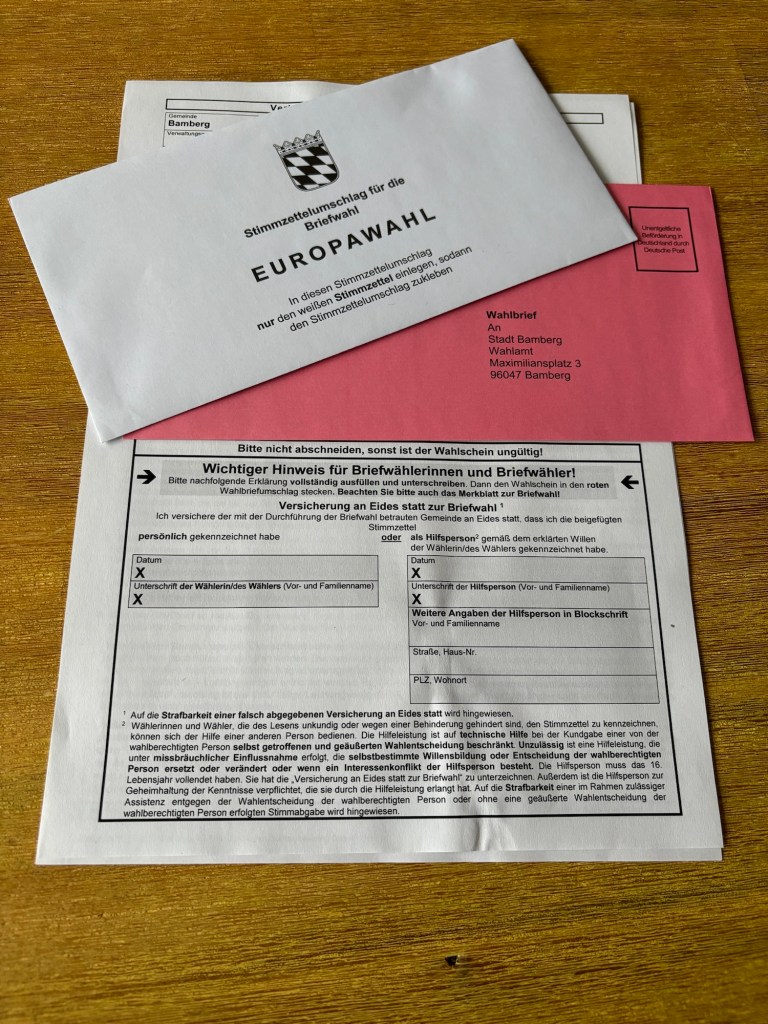
The large, slim envelope brought quite official business into our home and now it was time to open it. June 6 was the perfect day to open my absentee vote. D-Day.
The day, when thousands of British, American and Canadian soldiers set ashore in Normandy, France to fight against the Nazi regime and free Europe from the grip of an evil dictator and his allegiance. Eighty years later I’d uphold firmly as a German citizen living in a free Europe D stands for Democracy.
Paul Dickson quotes different meanings for D-Day:
Many explanations have been given for the meaning of D-Day, June 6, 1944, the day the Allies invaded Normandy from England during World War II. The Army has said that it is “simply an alliteration, as in H-Hour.” Others say the first D in the word also stands for “day,” the term a code designation. The French maintain the D means “disembarkation,” still others say “debarkation,” and the more poetic insist D-Day is short for “day of decision.” When someone wrote to General Eisenhower in 1964 asking for an explanation, his executive assistant Brigadier General Robert Schultz answered: “General Eisenhower asked me to respond to your letter. Be advised that any amphibious operation has a ‘departed date’; therefore the shortened term ‘D-Day’ is used.”
Paul Dickson: War Slang. American Fighting Words & Phrases since the Civil War, Mineola, New York 1994, p. 146.
D for day.
D for disembarkation.
D for debarkation.
D for decision.
D for departed date.
D for day.
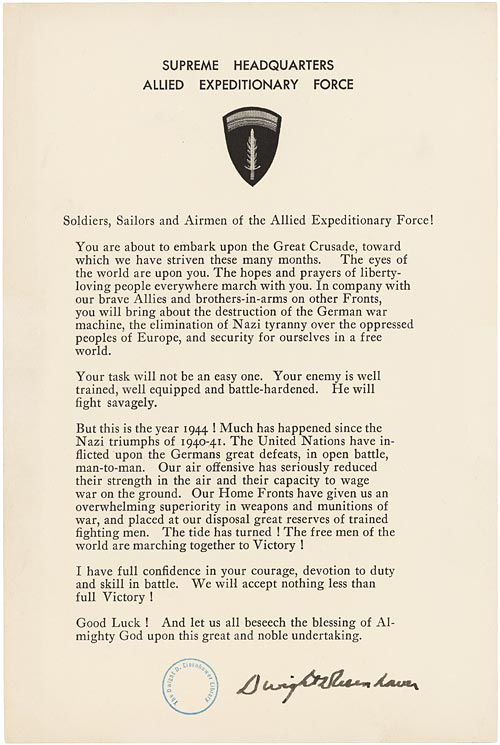
It was just passed midnight June 6, 1944. The bad weather over the English Channel had somewhat calmed down. The Allied commander-in-chief, US General Dwight D. Eisenhower, bid farewell to the men who would be risking their lives for democracy and peace in Europe:
Soldiers, Sailors, and Airmen of the Allied Expeditionary Force!
You are about to embark upon the Great Crusade, toward which we have striven these many months. The eyes of the world are upon you. The hope and prayers of liberty-loving people everywhere march with you. In company with our brave Allies and brothers-in-arms on other Fronts, you will bring about the destruction of the German war machine, the elimination of Nazi tyranny over the oppressed peoples of Europe, and security for ourselves in a free world.
Your task will not be an easy one. Your enemy is well trained, well equipped and battle-hardened. He will fight savagely.
But this is the year 1944! Much has happened since the Nazi triumphs of 1940-41. The United Nations have inflicted upon the Germans great defeats, in open battle, man-to-man. Our air offensive has seriously reduced their strength in the air and their capacity to wage war on the ground. Our Home Fronts have given us an overwhelming superiority in weapons and munitions of war, and placed at our disposal great reserves of trained fighting men. The tide has turned! The free men of the world are marching together to Victory!
I have full confidence in your courage, devotion to duty and skill in battle. We will accept nothing less than full Victory!
Good luck! And let us beseech the blessing of Almighty God upon this great and noble undertaking.
D-day statement to soldiers, sailors, and airmen of the Allied Expeditionary Force, 6/44, Collection DDE-EPRE: Eisenhower, Dwight D: Papers, Pre-Presidential, 1916-1952; Dwight D. Eisenhower Library; National Archives and Records Administration.
General Dwight D. Eisenhower’s Order of the Day (1944), in: National Archives.gov
D for disembarkation
175,000 men disembarked the huge ships. They arrived with tanks weighing more than 30 tons and with artillery. With carbines, machine guns, pistols, bayonets. With flamethrowers and mortars, pipe bombs and hand grenades, sticky explosives and mines. Their task: to conquer the continent. Even in the 5th year of the global conflagration, Europe was still largely controlled from Berlin.
Landing at Utah Beach. (Source: Wikipedia.com)
D for decision
It must have been a horrible decision, but a utmost courageous act that lead to breaking the tides in favour of democracy. It was the only way to free Europe from the deadly grip of the murderous Nazi regime. Casualties were enormous on all sides. Allied casualties were documented for at least 10,000, with 4,414 confirmed dead. German casualties on D-Day have been estimated at 4,000 to 9,000 men. Horrible numbers. Those, who had to make this important decision have been aware of the deadlines the day would bring upon uncounted families.
American Cemetery overlooking Omaha beach. (Source: wikipedia.com)
D for departed date
Brigadier General Robert Schultz once said that any amphibious operation has a ‘departed date’ – the shortened term ‘D-Day’. I understand this precise military term, but as I hold the absentee vote for the European election in my hands, D-Day has a very different and utmost important meaning for me as a German citizen living and breathing freedom with every breath I take in a free Europe.
D stands for Democracy
It is a covenant we must take by voting. Uncounted have fought for our freedom. Todays D-Day reminds us of this covenant we must take. D for Democracy. For a future in a free world. I will therefore vote for a democratic party, which will make our voice heard.
As I took the large absentee paper into my hands and made my cross fear crawled up my spine as memories of times past flashed through my mind. Hitlers party started off as a very small organisation and in a landslide took over Germany and half of Europe with its hateful and murderous ideology.
1926 German regional elections in Saxony: 1,6 %
1928 German State elections: 2,6 %
1930 German State elections: 18,3 %
1932 German State elections: 33,1 %
1933 German State Elections: 43,9 %
(Hans-Jörg und Gisela Wohlfromm: Und morgen gibt es Hitlerwetter! Alltägliches und Kurioses aus dem dritten Reich, S. 142)
Presently, we have a right winged party called „Alternative für Deutschland“ (AfD). It started as a protest party in 2013. Only four years later they received seats in the Bundestag (Federal German Parliament). They are forcefully voicing and living out right extremist ideas in a democratic Germany. Presently, 15,7% of the German population would vote for them. I would be lying, if I wouldn’t say that I am scared. There was a landslide back that brought Hitler into power.
I will use the only power I hold in my hands: a vote for a democratic party. It is a covenant every German and European citizen must make as our freedom was bought through the lives of those setting ashore on the beaches of Normandy June 6, 1944. May their souls rest in peace as they have handed-off the baton of democracy to us.
Schülerinnen und Schülern für ein Thema durch eine besondere Zugangsweise zu sensibilisieren ist für Pädagoginnen und Pädagogen von großer Relevanz. Graphic Novels stellen für mich im Sekundär- und Tertiärbereich der deutschen Schulbildung eine wichtige Zugangsmöglichkeit dar. Hierüber schrieb ich in einem vorhergehenden Blogpost (Link).
Nun stelle ich verschiedene Literaturtipps zur Antisemitismusprävention vor, die vor allem an Pädagoginnen und Pädagogen gerichtet sind, die in Sekundär- und Tertiärstufen unterrichten. Die meiste Literatur ist in deutscher Sprache erhältlich – wo dies nicht der Fall ist, weise ich darauf hin.
Dieser Blogeintrag soll eine Hilfe für Kolleginnen und Kollegen sein, um ihr eigenes Wissen gegen Antisemitismus zu stärken und durch Bildung gegen diese menschenverachtende, tödliche Häresie durch Bildung vorgehen zu können. Für die Vorstellung der Literatur habe ich einen Weg gewählt, der versucht, eine zeitliche Achse mit der Grundsätzlichkeit der Bücher zu kombinieren. Die Abfolge stellt keine Wertung in deren Bedeutung da, vielmehr gehören diese zu einer Vielzahl wichtiger Publikationen und wecken hoffentlich weiteres Interesse zur Vertiefung dieses Themas.
Liebe Kolleginnen und Kollegen, Bildung ist die wichtigste Waffe gegen Antisemitismus und jegliche Form des Menschenhasses. Lest gegen Hass und gebt dieses Wissen an die euch anvertrauten Schülerinnen und Schüler weiter!
„Die Natur des Vorurteils“ von Gordon Allport
Aus dem Englischen – als Übersetzung erhältlich
„The Nature of Prejudice“ (1954) wurde von Gordon Allport (1897-1967) verfasst, einem amerikanischen Psychologen, der mit diesem Werk die Grundlage für die Vorurteilsforschung gelegt hat. Laut Springerverlag ist es das meistgelesene Buch innerhalb der Sozialpsychologie.
Für mich war dieses Buch trotz der inkongruenten Bezugsgruppe (weiße, protestantische, amerikanische Männer) ein Augenöffner für eine Erklärung und einen Umgang mit Vorurteilen, die sich bis hin zu extremen Hass entwickeln können. Nicht nur stellte Allport das Aggressionskonzept von Sigmund Freud in Frage, sondern führte stattdessen ein Feedback- und Kommunikationsmodell ein. Der nachhaltigste Beitrag, der Politik und Gesellschaft veränderte, war sein Plädoyer für einen Kontakt zwischen Gruppen, die Vorurteile gegeneinander hegten, um somit Vorurteile vorzuschützen und daraus eventuell entstehenden Hass zuvor zu kommen.
Wer sich für die sozialpsychologische Betrachtung der Entstehung von Vorurteilen und Hass interessiert und durch einen theoretisch fundierten Hintergrund hiergegen in Schule und Bildungseinrichtungen vorgehen möchte, sei dieses Buch ans Herz gelegt.
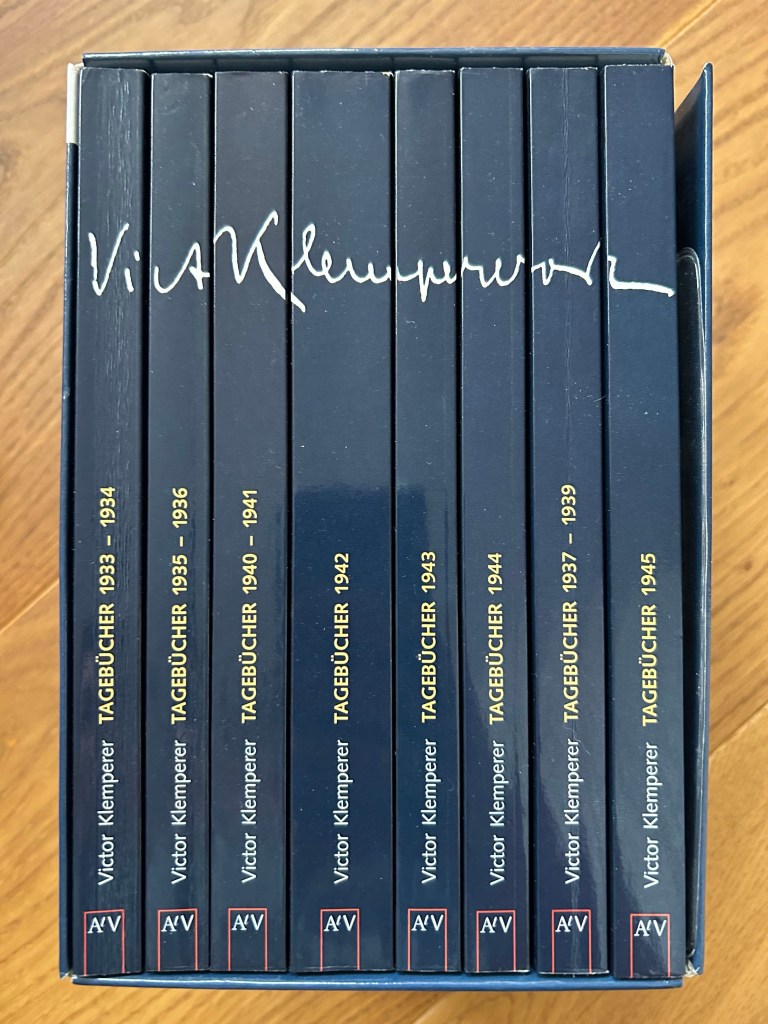
„Ich will Zeugnis ablegen bis zum letzten – Tagebücher 1933 bis 1945“ von Victor Klemperer
In Deutsch erschienen
Der deutsche Literaturwissenschaftler, Romanist und Politiker Victor Klemperer (1881-1960) ist einer der wichtigsten Zeitzeugen der NS-Schreckensherrschaft und deren mordender Brutalität, die akribisch vorbereitet und Sprache als ein grundlegendes Macht- und Beeinflussungsinstrument verwendet hatte.
In seinen Tagebüchern „Ich will Zeugnis ablegen bis zum letzten (1933–1945)“ dokumentierte er seine bitteren Alltagserfahrungen, die er als intellektueller protestantischer Konvertit jüdischer Herkunft innerhalb der der deutschen Gesellschaft des Nationalsozialismus sammeln musste. Für mich ist Klemperer einer der wichtigsten Chronisten, die das Leben in dieser Schreckensherrschaft in alltäglicher Sprache und Sicht transparent werden lassen.
Besonders bewegend und erschreckend sind für mich die schonungslosen Einblicke in eine diktatorische Alltagswelt, die alle Bereiche des Lebens ergriffen hatten. Die Erfahrung der Komplizenschaft vieler einst verlässlichen Personen in Nachbarschaft, Beruf und Familie zeigen, wie diese Diktatur in ihrer Schärfe erst durch sie ermöglicht wurde und sollte uns nachdenklich gegenüber unseren eigenen Handlungsweisen stimmen.
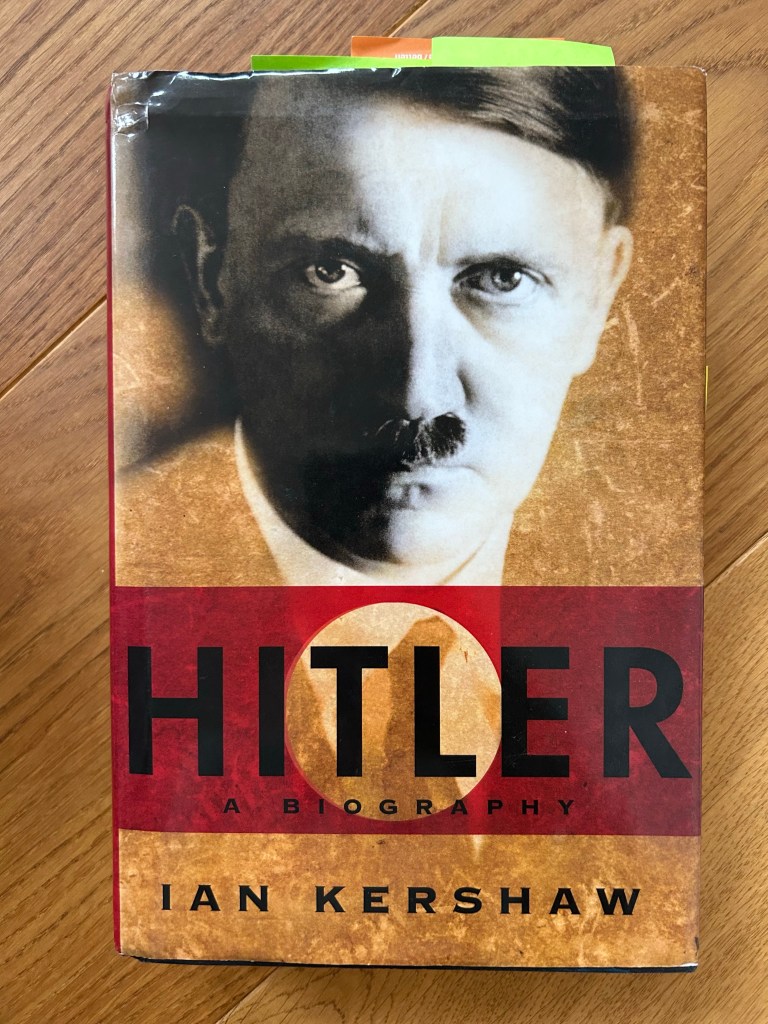
„Hitler – 1889 bis 1945“ von Ian Kershaw
Aus dem Englischen – als Übersetzung erhältlich
Ian Kershaw (*1943), englischer Historiker und Träger des Bundesverdienstkreuzes erster Klasse, nimmt in seiner Hitler-Biografie nicht nur die Person des Diktators in den Blick, sondern die gesellschaftlichen und politischen Umstände, die es ihm ermöglicht hatten, das schlimmste Unrechts- und Mordsystem der Neuzeit zu etablieren.
Kershaw beschreibt anschaulich und lebendig, mit faszinierender Kenntnis des Protagonisten seines Buches untermauert mit historischen Quellen den Aufstieg des verhinderten Kunstmalers und kleinen »Weltkriegsgefreiten« zum mächtigsten Mann Deutschlands, der eine totale Diktatur errichtete, die Welt in einen schlimmen Krieg stürzte und, der mit vielen Komplizen verantwortlich ist für die Ermordung von Millionen europäischer Juden.
Wichtig wurde mir durch diese Lektüre: ohne die Person Hitler sind die Schrecken des Zweiten Weltkrieges nicht vorstellbar. Aber: Ohne die Gefolgschaft der Deutschen ebenso wenig. Mögen wir diese Warnung ernst nehmen und uns selbst in unseren Handlungen einen kritischen Spiegel vorsetzen!
„LTI – Notizbuch eines Philologen“ von Victor Klemperer
Auf Deutsch erschienen und in viele Sprachen übersetzt
Im Englischen heißt dieses Werk übersetzt aus dessen ursprünglicher Bezeichnung „Lingua Tertii Imperii“ bezeichnend „The Language of the Third Reich“. Es ist die zweite Buchempfehlung von Klemperer, die ich aufgrund deren Grundsätzlichkeit gerne weitergeben möchte.
In diesem Buch analysiert Klemperer die Sprache des Nationalsozialismus und dessen Wirkmacht in bewegender und nachdenklicher Weise. Meine Polizeimeisteranwärterinnen und -anwärter weise ich stets darauf hin, dass Sprache ihre wichtigste Waffe darstellt. Umso wichtiger ist es daher, historische Kenntnis darüber zu haben, wie Sprache zum Bösen innerhalb unserer deutschen Geschichte verwendet wurde.
An dieser Stelle sei ebenso vermerkt, dass LTI 2003 unter dem Titel „Die Sprache lügt nicht“ (Originaltitel: „La langue ne ment pas“) für das Fernsehen als deutsch-französischer Dokumentarfilm von Stan Neumann adaptiert worden war. Dieser Film wurde im Juli 2005 beim Jerusalemer Filmfestival ausgezeichnet.
„Verbrannte Wörter – Wo wir noch reden wie die Nazis- und wo nicht“ von Matthias Heine
Auf Deutsch erschienen
Der deutsche Journalist und Buchautor Matthias Heine (*1961) nimmt uns in seinem Buch „Verbrannte Wörter“ mit auf eine wichtige Reise durch die deutsche Sprache und analysiert, inwieweit einzelne Begriffe einen nationalsozialistischen Hintergrund tragen oder vielleicht auch trotz einer Vermutung überraschender Weise doch nicht.
Wie steht es mit dem Begriff „Bombenwetter“, der immer noch verwendet wird?
Der „Aktion“, die immer noch in Organisationen wie „Aktion Mensch“ oder „Aktion Sühnezeichen“ zur Verwendung kommen?
Oder dem harmlos daherkommenden Ausdruck des „Hiwi“ als studentischer Hilfskraft?
Es sind erstaunliche Entdeckungen, die der Leser bei der Lektüre dieses Buches machen darf. Stets sind die einzelnen Begriffe gut eingebettet in geschichtliche Fakten und Referenzen, wie LTI als Quelle herangezogen. Der Autor macht am Ende jedes Begriffes eine kleine Empfehlung und regt dabei zur Entscheidung über eine etwaige Verwendung im eigenen Wortschatz an. Bei manchem hätte ich eine andere (strengere) Schlussfolgerung gezogen – doch in vielem kann ich dem Autor gut in einem Applizieren auf die sprachliche Praxis folgen.
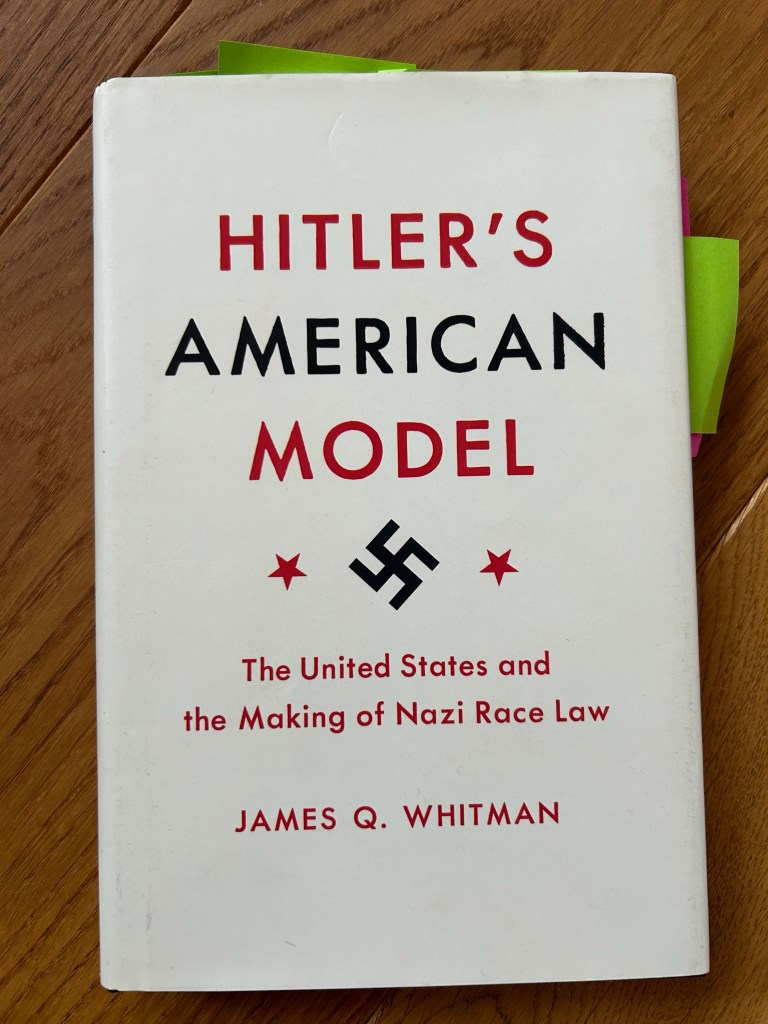
„Hitlers amerikanisches Vorbild: Wie die USA die Rassengesetze der Nationalsozialisten inspirierten“ von James Q. Whitman
Als Übersetzung aus dem Amerikanischen erhältlich
James Q. Whitman, Professor für vergleichendes und internationales Recht an der Yale-Universität ist einer der angesehensten Rechtshistoriker der USA. Er deckt in seinem Buch „Hitlers amerikanisches Vorbild“ eine überraschend schmerzhafte Tatsache auf: Die „Jim-Crow-Gesetze“ und der tief verankerte Rassismus in den USA waren eine massgebliche Anregung für die Rassengesetze der Nationalsozialisten. Es ist ein schmerzhaft wichtiger Aspekt, der mit diesem Buch beleuchtet wird und Sprengkraft auf dem amerikanisch-deutschen Verhältnis haben kann.
In meiner Dissertation, die auf amerikanisch-deutschen Horizont die Versöhnungsarbeit aufgreift, habe ich mich daher in einem Kapitel mit diesem „Zyklus des Bösen“ befasst und hierzu auch schmerzhafte Aspekte in Hitlers „Mein Kampf“ herausgearbeitet. (Tröstend begegnete mir bei meiner Recherche für meine Dissertation ein „Zyklus des Guten“ – doch dies ist vielleicht ein Thema für einen späteren Blogeintrag.)
„Plantations and Death Camps – Religion, Ideology, and Human Dignity“ von Beverly Eileen Mitchell
Gegenwärtig nur in Amerikanisch erhältlich
Während meines Dissertationsstudiums am Wesley Theological Seminary, Washington D.C., durfte ich mehrere Seminare bei Prof. Dr. Beverly Mitchell besuchen. Die historische Theologin hat nicht nur durch ihre Biografie und ihren scharfen Verstand einen tiefen Eindruck bei mir hinterlassen, sondern durch ihr Buch „Plantations and Death Camps“ mir die Augen hin zu einer Analogie des Grauens geöffnet.
In ihrem Buch vergleicht sie die menschenverachtende und vernichtenden Systeme der Plantagen und Konzentrationslager miteinander. Eine Zeitgleiche der Brutalität, die in die Abgründe menschlicher Seelen blicken lässt, die Macht, Gewinn und Unterdrückung über jegliche Menschlichkeit und Verbundenheit gesetzt hat. Die „Ideologien des Todes“, wie sie Mitchell bezeichnet, haben schlimme, verachtende und tödliche Konsequenzen diesseits und jenseits des Atlantiks hervorgebracht.
Das Buch ist ein Plädoyer, dies nie wieder geschehen zu lassen und regt zu einer eigenen biografischen Reflexion an. In einem vergangenen Blogeintrag (Link) schreibe ich hierüber.
„… trotzdem Ja zum Leben sagen. Ein Psychologe erlebt das Konzentrationslager“ von Viktor E. Frankl
Auf Deutsch erschienen
Viktor Frankl (1905-1997), der österreichische Psychiater, verbrachte mehrere Jahre in deutschen Konzentrationslagern. Hier wurde er mit unvorstellbarem Leid konfrontiert und musste sich mit der Frage auseinandersetzen, wie er und andere an diesen Orten der Unmenschlichkeit noch einen Sinn im Leben entdecken und die eigene Menschlichkeit bewahren konnte.
Für ihn war die Erfahrung, dass es möglich ist, auch noch unter inhumansten Bedingungen einen Sinn im Leben zu sehen, eine zentrale Entdeckung. Zukunftshoffnungen, von denen man getragen wurde, konnten über schwerstes Leid hinweghelfen – die Hoffnung, die Liebsten wiederzusehen oder, wie er sich vorstellte, nach einer Überwindung des Leides Vorlesungen geben zu dürfen, die die Auswirkungen des Lagers auf die Psyche zum Mittelpunkt hatten.
Dieses „Trotzdem“ hat bei mir tiefen Eindruck hinterlassen, vieles relativiert und die Gottesfurcht in den Mittelpunkt gestellt:
„So oder so – einmal kommt der Tag, für jeden der Befreiten, an dem er, rückschauend auf das gesamte Erlebnis des Konzentrationslagers, eine merkwürdige Empfindung hat: er kann es nun selber nicht verstehen, wie er imstande war, all das durchzustehen, was das Lagerleben von ihm verlangt hat. Und wenn es in seinem Leben einen Tag gab – den Tag der Freiheit-, an dem ihm alles wie ein schöner Traum erschien, dann kommt einmal der Tag, an dem ihm alles, was er im Lager erlöst, nur mehr wie ein böser Traum vorkommt. Gekrönt wird aber all dieses Erleben des heimfindenden Menschen von dem köstlichen Gefühl, nach all dem Erlittenen nichts mehr auf der Welt fürchten zu müssen – außer seinen Gott.“
… trotzdem Ja zum Leben, S. 139.
Einige von vielen Büchern, die Pädagoginnen und Pädagogen helfen können, sich durch Lektüren gegen Antisemitismus zu wappnen und dieses Wissen im Unterricht weitergeben zu können.
Lest gegen den Hass! Mit euren Schülerinnen und Schülern. Mit euren Kolleginnen und Kollegen. In Familien und Freundeskreisen.
Und kommt durch Unterhaltungen und Diskussionen auf Antisemitismus zu sprechen – einer menschenverachtenden und tödlichen Irrlehre, die Demokratie und Menschenwürde diametral entgegengesetzt ist. Damit sie in den Herzen und Gedanken nicht auf fruchtbaren Boden falle.
– Updated Version (Aug 27, 16:50 GMT +2) : including Rick Landmans memories of his father –
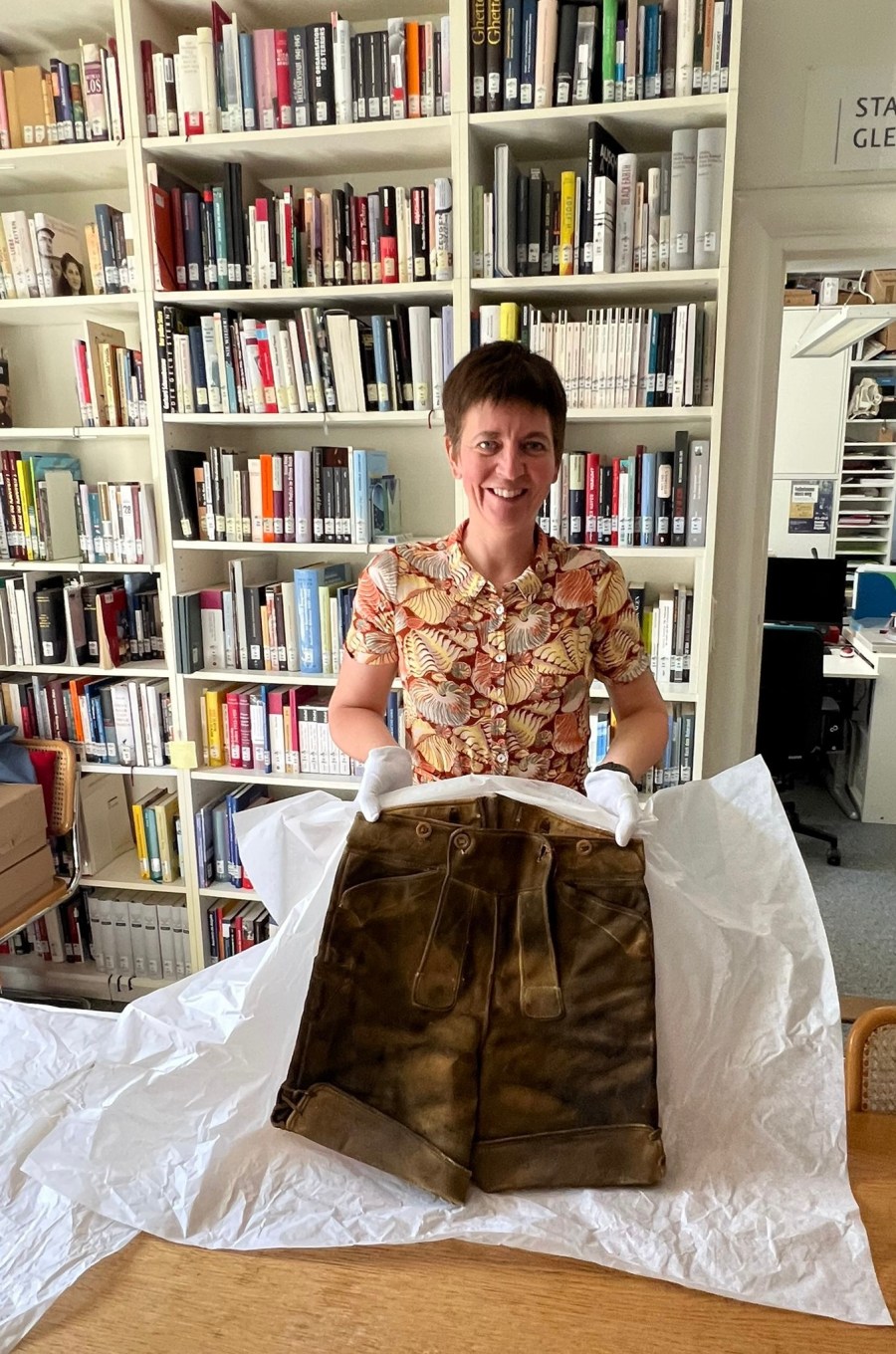
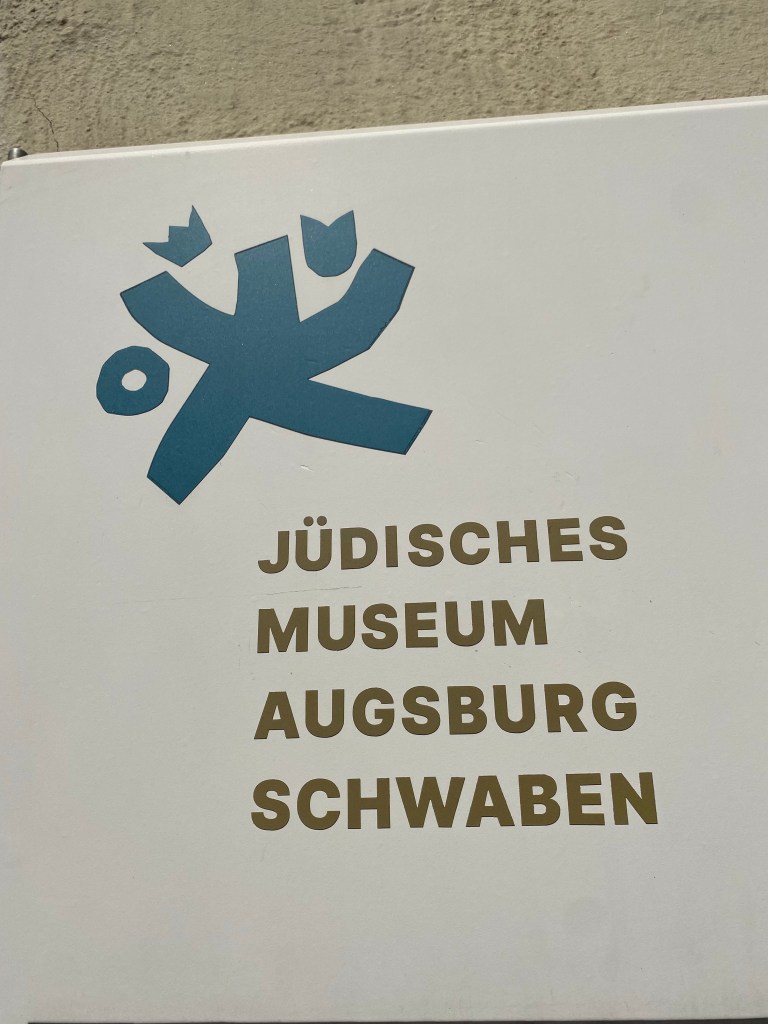
I stood in awe as I looked down at the brown lederhosen, which had been carefully placed in my hands. My gloved hands touched the matured leather. I could see by look and experience that this pair of German traditional clothing had been devotedly worn and looked after neatly as well. What I held in hands was the Lederhosen of Henry Landman. His son Rick, a dear friend, had told me about this special piece of clothing. Now Mrs. Müller, the deputy director of the Jewish Museum Augsburg Schwaben had especially brought it from the archives for me to see as I visited the museum on this hot August afternoon.
I was moved to tears, because it not only made me feel close to Rick, but held an important artefact of history in my hands. If the Lederhosen could speak, they would tell the hurtful, but ever so strong story of Henry Landman.
Rick Landman writes about this difficult chapter in his fathers life via Facebook:
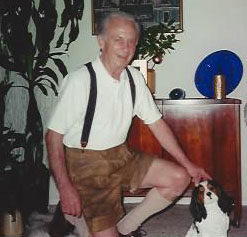
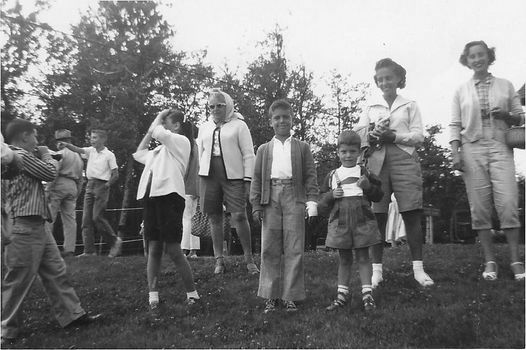
The Gestapo arrested my dad on the day after Kristallnacht (November 10, 1938) at 5 am while he was still in bed. When he got up he put on his Lederhosen and when he reached Dachau he turned them in. They put them in a brown paper bag with his Dachau Number on it. When he was later released they returned them to him to be able to go home. His father who was released earlier was able to get him a Temporary Transit visit to get to London. He was 18 and too old for the Kindertansport. On April 15, 1939, my dad as an unaccompanied teenager made his way to London and he either took the Lederhosen with him, or packed them in the lift that he sent to NYC the week before. Growing up in NYC I remember my dad wearing them while doing the gardening. [If you check out my COMMENTS] you can see a photo of my dad trying on the Lederhosen before we sent them to the Museum, and a photo of me wearing my Lederhosen in the Catskills when I was a child.
Rick Landman, via Facebook
(Pictures: Rick Landman)(Pictures: Rick Landman)
Henry had been arrested in this very traditional German clothing I held in my hands many years later in Augsburg. At his release he was handed all his belongings back, which included the Lederhosen. Henry emigrated to the U.S. just in time and returned six years later in the very different clothing of a US-Soldier to Germany to liberate the Jewish people.
Father like son, Rick is a very inspiring person. On his website he gives touching insights in to his biography. For the 70th anniversary of the liberation of Dachau he wrote for the „Gedächtnisbuch für Häftlinge des KZ Dachau“ about his late fathers experience as a liberator of Dachau:
[…] In 1945, the town of Dachau had one major road with a few side streets off to the sides. When he arrived the street was full of people shouting, eating, looting, and running around either in exuberance of their new freedom or fear of what will happen next. Colonel Porter gave him a jeep, and while riding down the street, a woman in a long black dress jumped into the middle of the street waving her hands trying to get my father’s attention. His jeep stopped and my father hopped out in his U.S. Army uniform, carrying his rifle and went up to her asked her what she wanted. Her face showed a combination of urgency and fear, but she calmed down and motioned him to go with her into a small house with a bakery on the ground floor. She wanted to get off the street before she would tell him why she was so frantic. When inside, she explained that someone was hiding downstairs who wanted to surrender directly to an American soldier. She said that she just wanted him out of her house and didn’t know what to do.
The man who ran into her store was still wearing his S.S. uniform and was more afraid of the newly liberated concentration camp prisoners than he was of the U.S. Army. My father went down a spiral staircase pointing his rifle as he slowly descended, and there hovering in the corner, was probably a former Captain in charge of the S.S. officers at Dachau Concentration Camp. When the Nazi officer saw my father, he stood up and saluted him with an American salute and he said that he wanted to surrender to an American, and be away from the mob of former inmates. The whole thing was so bizarre to my father who could still remember being in Dachau as an inmate. Even if this man was not the same Captain as in 1938, the thought of my father being the savior of an S.S. officer was quite ironic. In retrospect, my father wondered if the Captain was actually the son of the screaming woman, and she tricked him into saving her son.
My father didn’t explain who he was and why he spoke German and just let them wonder if all of the U.S. soldiers were as conversant as he. The Captain walked upstairs with his hands over his head, and then my father and the other soldier who was watching the jeep put the Captain on the hood of the jeep and told him to hold on to the metal bar that was attached to the front bumper. This bar was the latest invention of the Americans to try to keep them from being decapitated. The Germans would tie a thin wire around a tree on one side of the street and then cross the street and tie it to another tree, hoping that the American soldiers in the convertible jeeps would ride by and have their heads sliced off.
My father didn’t have to worry this day about any decapitation. In addition to the outreaching metal stick, he had a Nazi officer in the front who would feel any wire before they would. As my father drove down the main street of Dachau with this prominent Nazi on the hood, he remembered that six years earlier he was released from Dachau and was told that he better get out of Germany, because the next time he ended up in that camp, he wouldn’t be getting out alive. Now six years later, he was an American soldier saving the life of a man in charge of all that killing.
Such remarkable and moving experiences – I do not know, how Henry was able to see it all through. Both, the Lederhose I was allowed to see on this remarkable day in August, and the jacket of Henry Landman´s uniform, are in the safe keeping of the Jewish Museum Augsburg Schwaben as an important reminder of history. While this part of history is well documented thanks to the Landman family, Rick and I want to work on reconciling the broken past of our Franconian home town.
You have to meet him! He’s only a few miles away in Manhattan. What a delight it would be, to connect two of my favourite people and maybe someday have both of you with us here in Germany as we try to reconcile history through friendship and important lessons of the past for a brighter future.
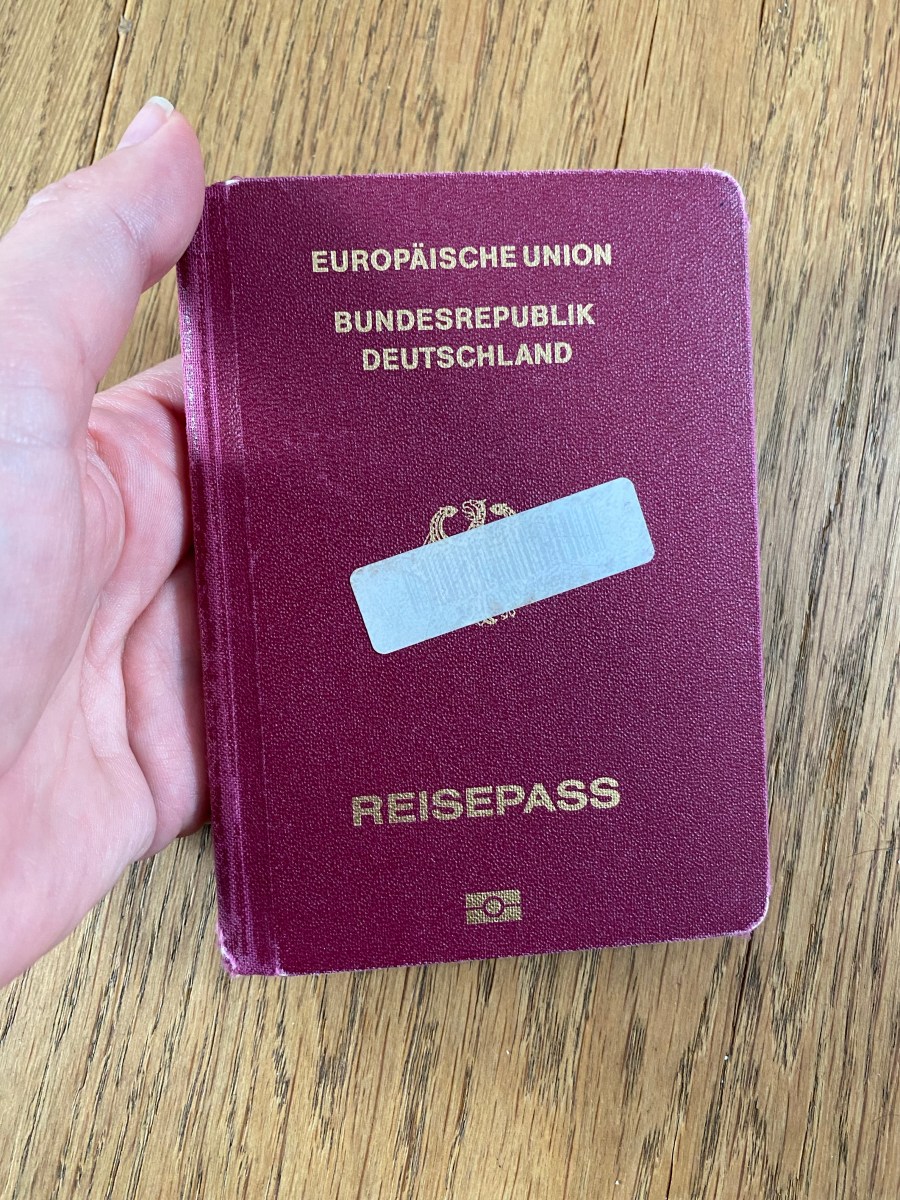
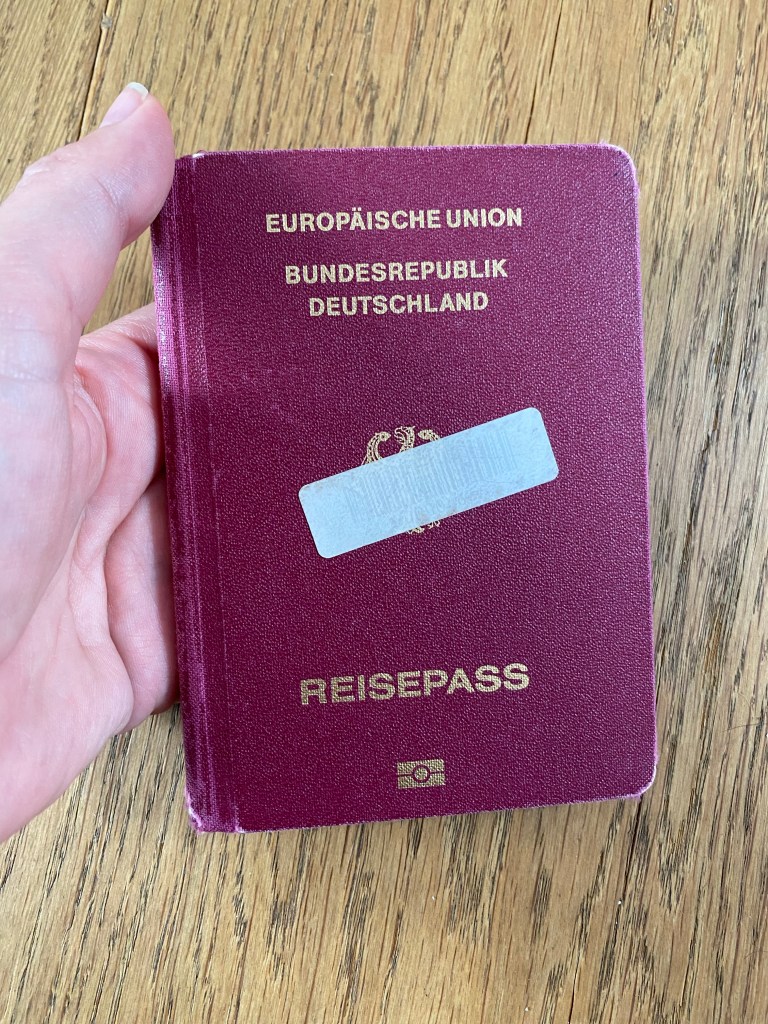
Preparing for an upcoming lesson I had dug out my seasoned passport. My thumb ran over the rounded edges and the large white registering sticker of my visa that was placed over the federal eagle and had almost been rubbed off. The many travels I had made with this faithful companion had given this important document a soft appearance.
For the upcoming week I was asked to be part of a role play to help my police cadets prepare for a standard situation: I would play a passenger, who needs to identify herself to the authorities while traveling. „Pretty straight forward“, I quietly said to myself. I love being part of these vital practises as they help our young trainees to grow into their new, responsible role as representatives of the German government. But this practise would have a different, very deep meaning as it the responsibility growing from its day to day practise at German airports, train stations and borders was rooted in the darkness of the German past.
How many times had I taken for granted that I would not be in danger when handing my passport to an immigration officer? I can’t recall how often I had presented it while travelling from the United States to Germany and back. My German passport comes along with a lot of privileges citizens of other countries do not have. According to the Henley Passport Index it is listed on 3rd place worldwide for visa-free travel. Whenever I was holding this small, but powerful form of identification in my hand, I always felt secure when handing it over.
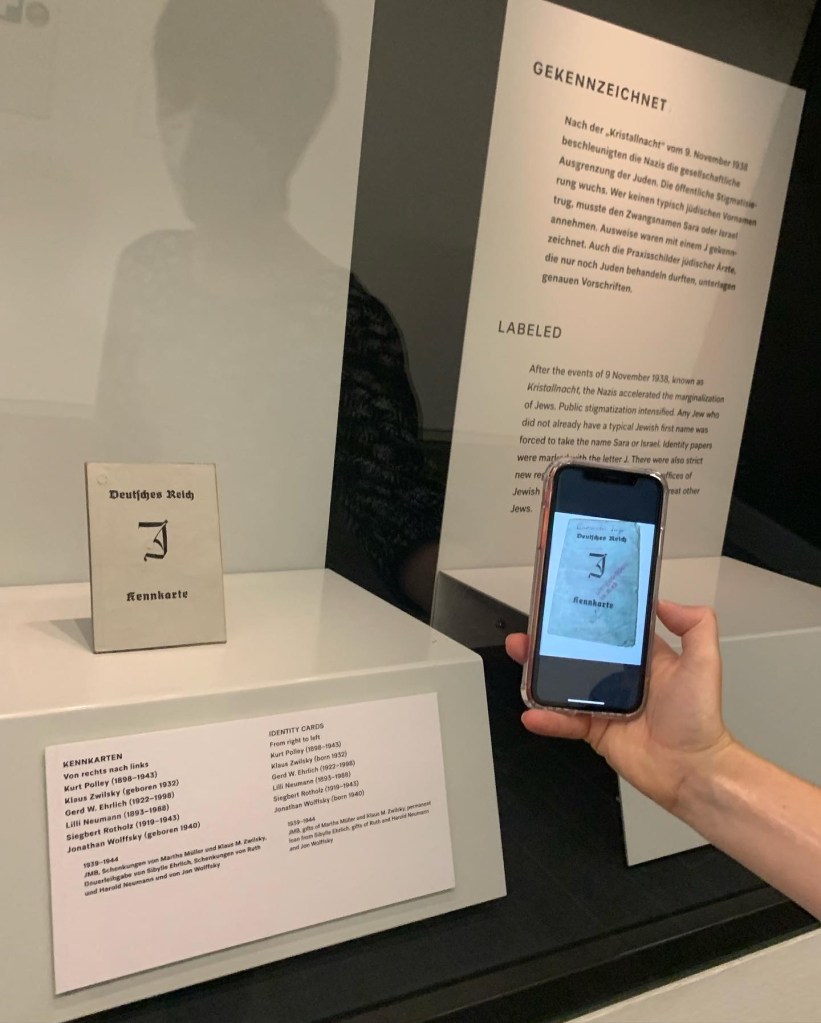
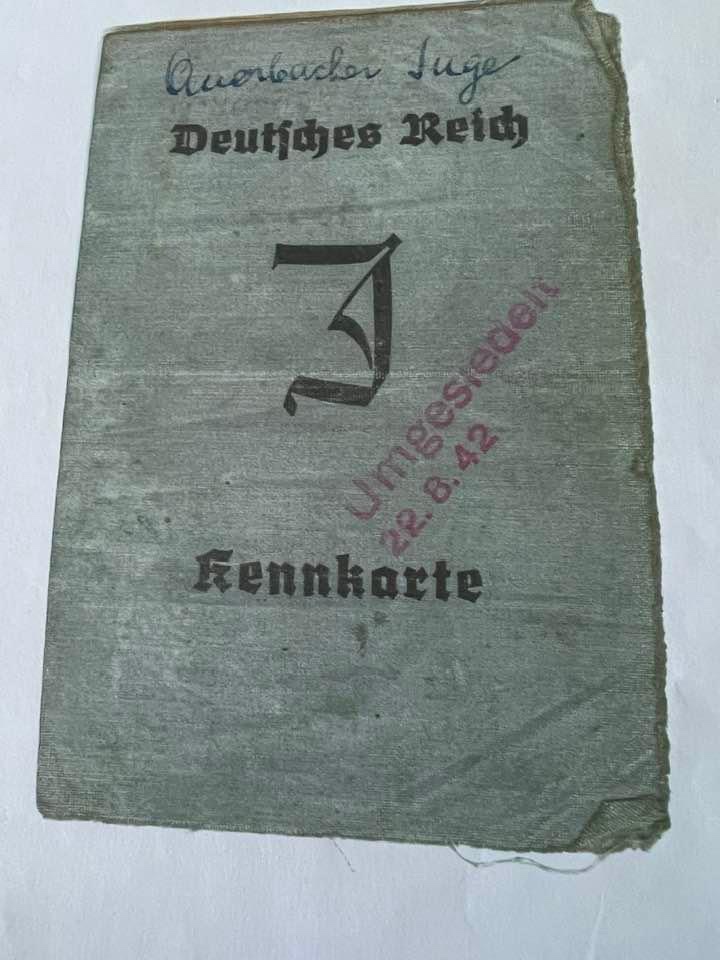
But there have been times in Germany, when certain forms of identification haven’t been a protection, but an endangerment for those holding them. Inge Auerbacher, who is a Holocaust survivor and whom I was honoured to meet in New York, knows through hurtful experience. Just a few weeks ago I stood with in front of an exhibition about „Kennkarten“ at the Jüdisches Museum Berlin as tears rolled down my cheeks. It was exactly on the day when Inge had left Germany. This day was marked by authorities in red letters across her German identification card, which was back then called „Kennkarte“.
(Picture right : by the courtesy of Inge Auerbacher)
The „Kennkarte“ was the basic identity document, which was used during the Third Reich. The murderous regime quickly used this form of identification as a weapon of control and fear. Unfortunately, Germany back then had been very efficient in the layout of bureaucracy. Letters on the outside of the „Kennkarte“ were introduced to mark each ethnicity – J for Jews, U for Ukrainians, R for Russians, W for Belarusians, K for Georgians, G for Goralenvolk, Z for Roma and Sinti.
I can’t possibly imagine what kind of fear it must have evoked as a person with such a letter had to produce their ID to an officer. After seeing Inge´s Kennkarte I will never ever take such freedom for granted. Encountering her story, took my teaching at the Federal Police to a deeper level. As long as I am allowed to, I will talk with my cadets about their responsibility to be guards of democracy and human worth. Back then, the police force was a terrible accomplice of the murderous Nazi regime enabling fear and becoming an instrument of its terror. Today, as long as I am permitted to teach, I will tell the stories of hurt, loss and disaster to help the young police officers to remember this terrible time in Germany and become a vital part of resistance against any form of exclusion, dictatorship and executive terror.
I sighed deeply as I slid my passport into my bag. What a privilege and responsibility. Maybe this is one of the reasons I was called back to Germany: that we remember these horrible times and stay committed to democracy and justice so people feel safe as they enter and life Germany.
I stared at the old picture in awe. Six men and a women were gathered around an embroidered table and deliciously filled beer steins. In the center of the picture was a gentleman with a hat and beard, who clearly looked Jewish. He proudly glanced back at me. As my gaze wandered over the details of this special snap shot in time I spotted two police officers to the left and right. They were a natural part of this cheerful and positive happening.
Uffenheim in the 1890s or 1900s. A window into the life of my hometown before Hitlers murderous thoughts, his evil making and hating ideology took grip of Franconia and the place I grew up.
The picture you see on the bottom is from my friend Rick Landman. By G´d´s providence we met years ago in New York. Who would have ever dreamed that the friendship, which once flourished before the disaster of the Nazi-Regime, would be reinstated by two Uffenheimer finding each other amongst millions of people in one of the busiest cities of this world?
(Bild: Rick Landman)
The proud Jewish gentleman in the middle is Ricks great-grandfather Gabriel Oettinger (1862-1903). He was able to experience as Jewish people became full citizens in Germany 1871. To me he looks happy and proud – along with all the other people. I can fully understand, as I’ve experienced how enriching, enlightening and heart-warming diverse and welcoming societies can be, if they dare to. The New York experience of diversity has changed my heart and soul forever.
Nonetheless, with emancipation having blossomed in Germany within years the pendulum swung back under the Nazi regime to an even more disastrous state than ever before. My hometown Uffenheim prided itself to be „judenfrei“ before everyone else and adhering to the Nazi regime more than other places. Martin Oettinger (Ricks grandfather), who was a proud born Uffenheimer, had to flee for his life.
The old picture is a proof that a different kind of society is possible- even in Uffenheim, which has once adhered so eagerly to a murderous regime and is presently very conservative. As I am now not only carrying the weight of my ancestors doings, the guilt of my Lutheran church body, but by wearing a Police uniform as a chaplain I am responsible to embrace the complicitness of this institution during Hitler as well. I hope that the picture of friendship, joy and happiness once taken in Uffenheim will foreshadow what can be in the presence and future: By reinstating a friendship amongst those, who once shared the same table, there is hope beyond time through those embracing each other in love and commitment.
May this new picture be a hopeful beginning of what once was possible in the small Franconia town of Uffenheim.
Information about Rick Landman and his family’s story, please visit his website.















 Miriam Gross