My dear Jewish friend 20: D stands for Democracy

D-Day and the European election – a covenant for democracy

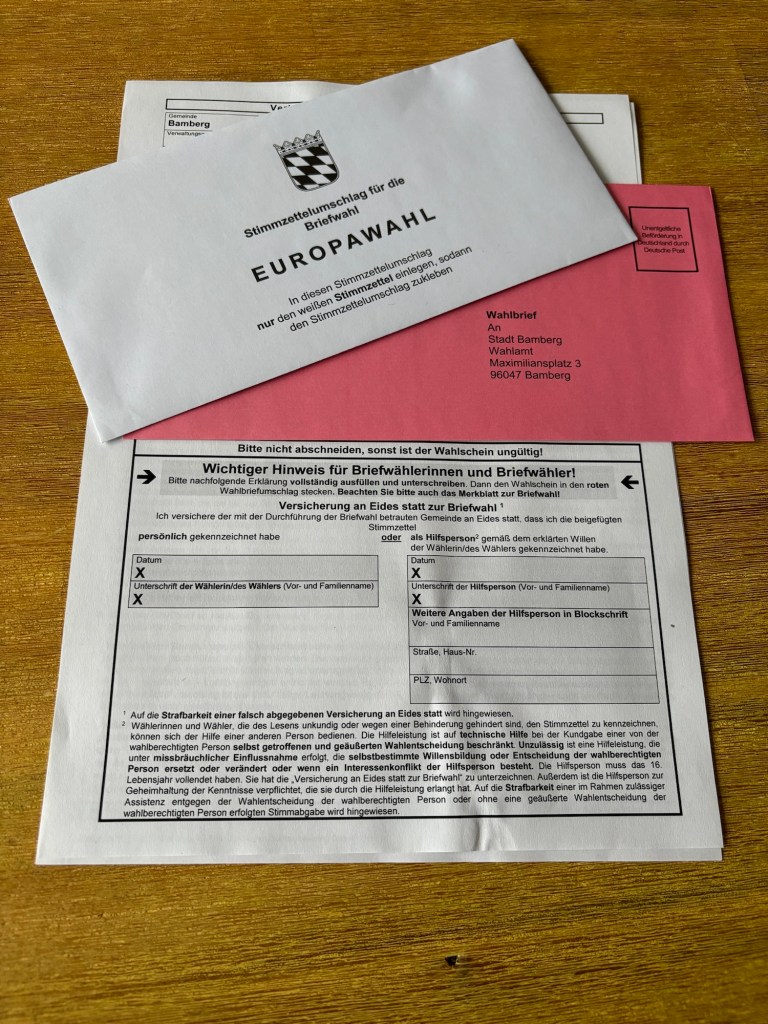
The large, slim envelope brought quite official business into our home and now it was time to open it. June 6 was the perfect day to open my absentee vote. D-Day.

The day, when thousands of British, American and Canadian soldiers set ashore in Normandy, France to fight against the Nazi regime and free Europe from the grip of an evil dictator and his allegiance. Eighty years later I’d uphold firmly as a German citizen living in a free Europe D stands for Democracy.

Paul Dickson quotes different meanings for D-Day:

Many explanations have been given for the meaning of D-Day, June 6, 1944, the day the Allies invaded Normandy from England during World War II. The Army has said that it is “simply an alliteration, as in H-Hour.” Others say the first D in the word also stands for “day,” the term a code designation. The French maintain the D means “disembarkation,” still others say “debarkation,” and the more poetic insist D-Day is short for “day of decision.” When someone wrote to General Eisenhower in 1964 asking for an explanation, his executive assistant Brigadier General Robert Schultz answered: “General Eisenhower asked me to respond to your letter. Be advised that any amphibious operation has a ‘departed date’; therefore the shortened term ‘D-Day’ is used.”

Paul Dickson: War Slang. American Fighting Words & Phrases since the Civil War, Mineola, New York 1994, p. 146.

D for day.

D for disembarkation.

D for debarkation.

D for decision.

D for departed date.

D for day.

It was just passed midnight June 6, 1944. The bad weather over the English Channel had somewhat calmed down. The Allied commander-in-chief, US General Dwight D. Eisenhower, bid farewell to the men who would be risking their lives for democracy and peace in Europe:

Soldiers, Sailors, and Airmen of the Allied Expeditionary Force!

You are about to embark upon the Great Crusade, toward which we have striven these many months. The eyes of the world are upon you. The hope and prayers of liberty-loving people everywhere march with you. In company with our brave Allies and brothers-in-arms on other Fronts, you will bring about the destruction of the German war machine, the elimination of Nazi tyranny over the oppressed peoples of Europe, and security for ourselves in a free world.

Your task will not be an easy one. Your enemy is well trained, well equipped and battle-hardened. He will fight savagely.

But this is the year 1944! Much has happened since the Nazi triumphs of 1940-41. The United Nations have inflicted upon the Germans great defeats, in open battle, man-to-man. Our air offensive has seriously reduced their strength in the air and their capacity to wage war on the ground. Our Home Fronts have given us an overwhelming superiority in weapons and munitions of war, and placed at our disposal great reserves of trained fighting men. The tide has turned! The free men of the world are marching together to Victory!

I have full confidence in your courage, devotion to duty and skill in battle. We will accept nothing less than full Victory!

Good luck! And let us beseech the blessing of Almighty God upon this great and noble undertaking.

D-day statement to soldiers, sailors, and airmen of the Allied Expeditionary Force, 6/44, Collection DDE-EPRE: Eisenhower, Dwight D: Papers, Pre-Presidential, 1916-1952; Dwight D. Eisenhower Library; National Archives and Records Administration.
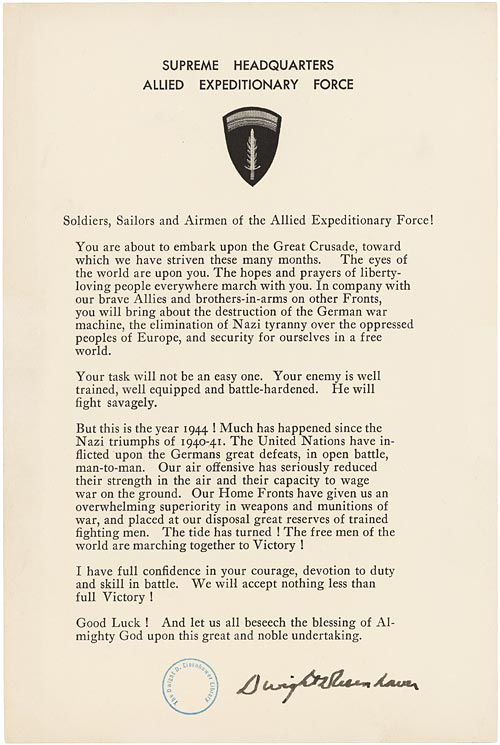
 General Dwight D. Eisenhower’s Order of the Day (1944), in: National Archives.gov

D for disembarkation

175,000 men disembarked the huge ships. They arrived with tanks weighing more than 30 tons and with artillery. With carbines, machine guns, pistols, bayonets. With flamethrowers and mortars, pipe bombs and hand grenades, sticky explosives and mines. Their task: to conquer the continent. Even in the 5th year of the global conflagration, Europe was still largely controlled from Berlin.

Landing at Utah Beach. (Source: Wikipedia.com)

D for decision

It must have been a horrible decision, but a utmost courageous act that lead to breaking the tides in favour of democracy. It was the only way to free Europe from the deadly grip of the murderous Nazi regime. Casualties were enormous on all sides. Allied casualties were documented for at least 10,000, with 4,414 confirmed dead. German casualties on D-Day have been estimated at 4,000 to 9,000 men. Horrible numbers. Those, who had to make this important decision have been aware of the deadlines the day would bring upon uncounted families.

American Cemetery overlooking Omaha beach. (Source: wikipedia.com)

D for departed date

Brigadier General Robert Schultz once said that any amphibious operation has a ‘departed date’ – the shortened term ‘D-Day’. I understand this precise military term, but as I hold the absentee vote for the European election in my hands, D-Day has a very different and utmost important meaning for me as a German citizen living and breathing freedom with every breath I take in a free Europe.

D stands for Democracy

It is a covenant we must take by voting. Uncounted have fought for our freedom. Todays D-Day reminds us of this covenant we must take. D for Democracy. For a future in a free world. I will therefore vote for a democratic party, which will make our voice heard.

As I took the large absentee paper into my hands and made my cross fear crawled up my spine as memories of times past flashed through my mind. Hitlers party started off as a very small organisation and in a landslide took over Germany and half of Europe with its hateful and murderous ideology.

1926 German regional elections in Saxony: 1,6 %

1928 German State elections: 2,6 %

1930 German State elections: 18,3 %

1932 German State elections: 33,1 %

1933 German State Elections: 43,9 %

(Hans-Jörg und Gisela Wohlfromm: Und morgen gibt es Hitlerwetter! Alltägliches und Kurioses aus dem dritten Reich, S. 142)

Presently, we have a right winged party called „Alternative für Deutschland“ (AfD). It started as a protest party in 2013. Only four years later they received seats in the Bundestag (Federal German Parliament). They are forcefully voicing and living out right extremist ideas in a democratic Germany. Presently, 15,7% of the German population would vote for them. I would be lying, if I wouldn’t say that I am scared. There was a landslide back that brought Hitler into power.

I will use the only power I hold in my hands: a vote for a democratic party. It is a covenant every German and European citizen must make as our freedom was bought through the lives of those setting ashore on the beaches of Normandy June 6, 1944. May their souls rest in peace as they have handed-off the baton of democracy to us.

D-Day stands for Democracy.

My dear Jewish friend 15: As German Federal Police #WeRemember

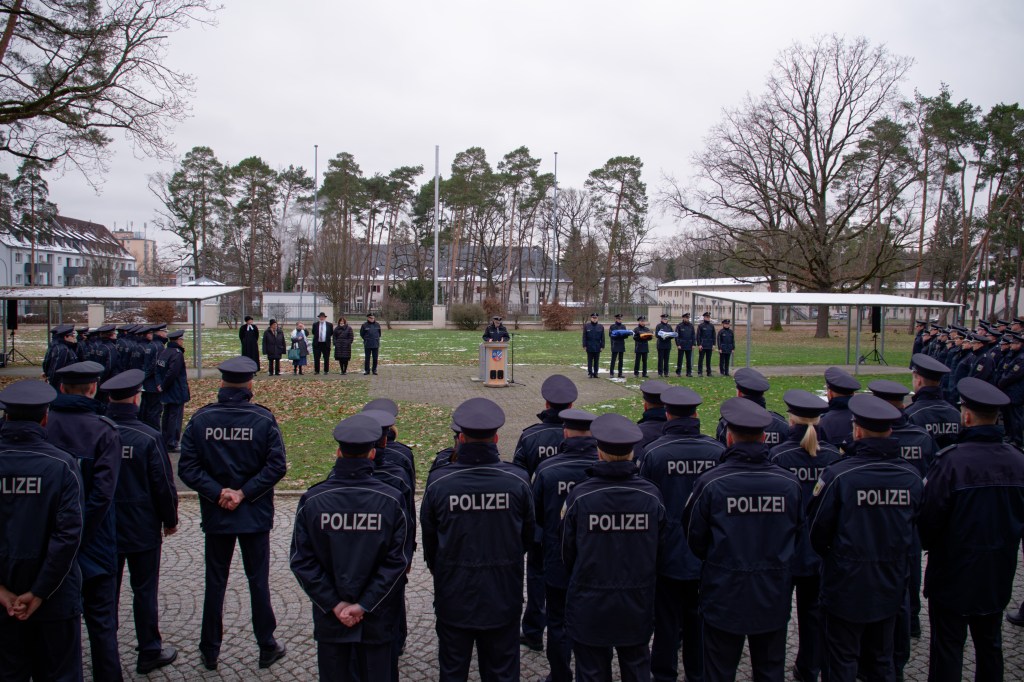
I held my breath as the young police cadet started reading the names of places that once have been places of horror and death.

Auschwitz

Buchenwald

Dachau

It was Holocaust Remembrance Day. This year January 27 was a cold, crisp day with old snow and icy edges giving roads and sidewalks a rough appearance. As I made a small remark about the weather, the Rebbetzin, who stood next to me, looked at me and nodded: „I’ve heard that the weather on the day of the liberation of Auschwitz must have been the same.“ A cold shiver ran like a lighting down my spine and made me shiver even more.

(All Pictures: Bundespolizei / Stabstelle Öffentlichkeitsarbeit / AFZ Bamberg)

Flossenbürg

Groß-Rosen

Hinzert

To commemorate the liberation and commemorate the victims of the Holocaust, we had organised a ceremony at the Training Facility of the Federal Police in Bamberg. As its chaplain it was important to me. Not only am I a German citizen, but a clergy working for the Federal Police. Both, police and churches have been hurtfully complicit during the Nazi regime. My commitment is therefore even more urgent and our friendship has sealed my personal responsibility in ways I can’t describe.

Majdanek

Mauthausen

Mittelbau

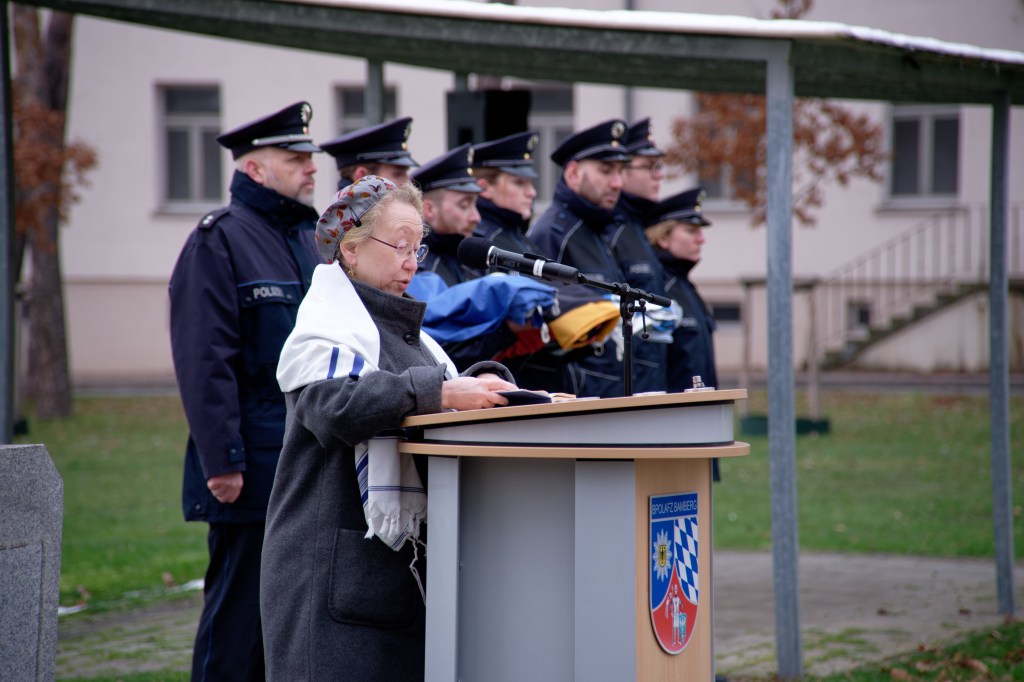
Nine classes of police cadets with their teachers plus the leadership had gathered in neatly arranged rows. Over one hundred and fifty people in total filled the large space, which once was called „The Change of Command“ when the facility was an U.S. military base. Rabbi Dr. Yael Deusel, Rabbi Dr. Almekias-Siegel with Rebbetzin, and Mr. Rudolph, the chair of the Synagoge in Bamberg had followed my invitation to the commemoration ceremony. I was thankful that they joined us during this important remembrance to read a prayer. Many of my police cadets never have personally met Jews – and certainly haven’t had the honour to meet Rabbis.

Natzweiler-Struthof

Neuengamme

Riga-Kaiserwald

The grounds on which we stood on January 27 couldn’t have been more ambivalent and made a commemoration even more important. The land was used for military reasons for a long time. First built as the „Lagarde Kaserne“ for the Royal Bavarian Army as an infantry barracks, it was extensively used during World War I and World War II. It is said that almost every branch of the German Army was stationed here. The most elite group was the 35th Armor and the 17th Cavalry Regiments, which was composed of noblemen who were wealthy and had their own riding school. Claus von Stauffenberg was its most prominent member. He was known for an unsuccessful plot to assassinate Adolf Hitler. When both Rabbis presented their prayers I was filled with deep thankfulness. Hitlers evil plans hadn’t worked out – even if he did use this stretch of land decades ago, it is now under the leadership of Leading Police Director Thomas Lehmann used to educate generations of police cadets to uphold democracy and human rights.

Sachsenhausen

Stutthof

Plaszow

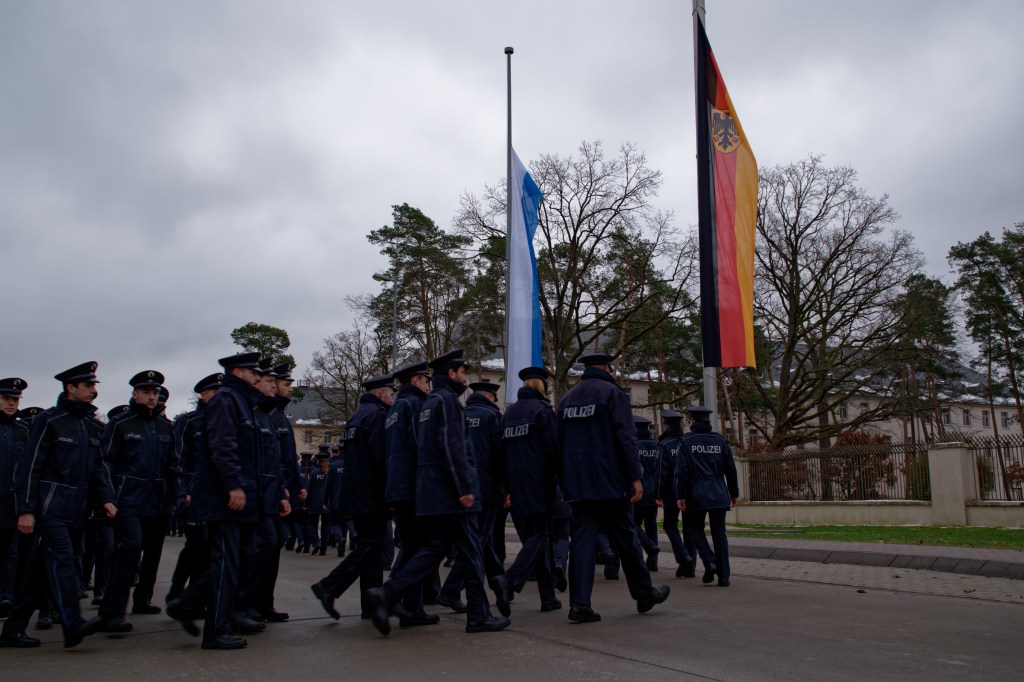
As Leading Police Officer Thomas Lehmann lead the Rabbis to the flag masts, we were supported by rows of police cadets and their leadership. While making our way to the masts, it felt as if they were forming a protective back up for those, who were grieving in remembrance. It might have been the same cold day in 1945 and 2023, but what happened back then, will never happen again. I can assure you, that many together with me will give their very best. May the memories of the victims never be forgotten, but for a blessing as we train young police cadets to protect and serve democracy.

My dear Jewish friend 8: Remembering and committing as Police

I carefully placed the large candles on both sides of the table, then arranged the white framed picture, book and the program in the center. As the candles burned I waited in the quietness of the morning for my colleagues for the briefing and the following holocaust remembrance. For me it was a tripple commitment as a German citizen, Christian pastor, and now working for the Federal Police since almost a year. The epaulet with a golden cross on my shoulder visiualized my double responsibility for the church and the Federal Police.

When I broke the news to you over a year ago that I would be leaving New York to be called to the Federal Police we shed tears. We instantly knew that something special would very soon be no longer part of our routine: the strolls in our neighbourhood chatting about our lives, working together in your food pantry for the poor, and sharing joy, laughter, and tears.

Even though I still can’t get used to be so far away – to be exact 3.923 miles – this January morning gave me the feeling that our pain of distance at least makes some sense as I remembered with other leading police officers the crimes of the Holocaust. When the Police director spoke of the responsibility remembering and committing to never forget what had happened to your people and so many others during the Nazi horrors, my heartbeat increased. I was proud to hear that the German Police, which was complicit like many other institutions including my Bavarian Lutheran Church, commits to securing human rights and the German constitution.

This commitment is central as I teach young police trainees in ethical decision making. But let me try to briefly recall what happened back then with policing making the Police force a significant element of the muderous Nazi-regime. (For further information follow the link to the German article about Policing during the Third Reich)

The rise of the Hitler movement began against the background of economic and
political crisis of the Weimar Republic. The brutal regime took advantage of the difficult situation of million Germans. Hitler and others in power legally created system of injustice that was aimed at installing a National Socialist-oriented community, which was „liberated“ from any „un-German spirit“.

Essential feature was the so-called „Verreichlichung“, in which the Police force was centralised by the Nazi rulers and became its outward appearance through the „Reichssicherheitshauptamtes“ (Reich Security Main Office) in 1939. From spring 1933 until the end of the war in 1945 the police apparatus received extensive new possibilities to intervene and monitor. In addition, the boundary between „law enforcement“ and „security police“ become blurred in favour of the SS, which ultimately held all powers. To make things worse, the population supported the daily terror of the Secret State Police by
willingly denunciating their fellow citizens.

Police battalions and task forces not only took part in the organisation of the Holocaust in the Germany and occupied areas, but were involved in mass shootings in East Europe and therefore directly took part in the Nazi genocide.

After celebrating six very meaningful Holocaust Remembrance Days in New York, it was this day that added an important mew layer to my commitment as a German citizen, and a pastor working in and for the German Federal Police. May we learn from the disaster of the Holocaust to never make it happen again to anyone, no matter what religion, nationality, or skin color the person might have.

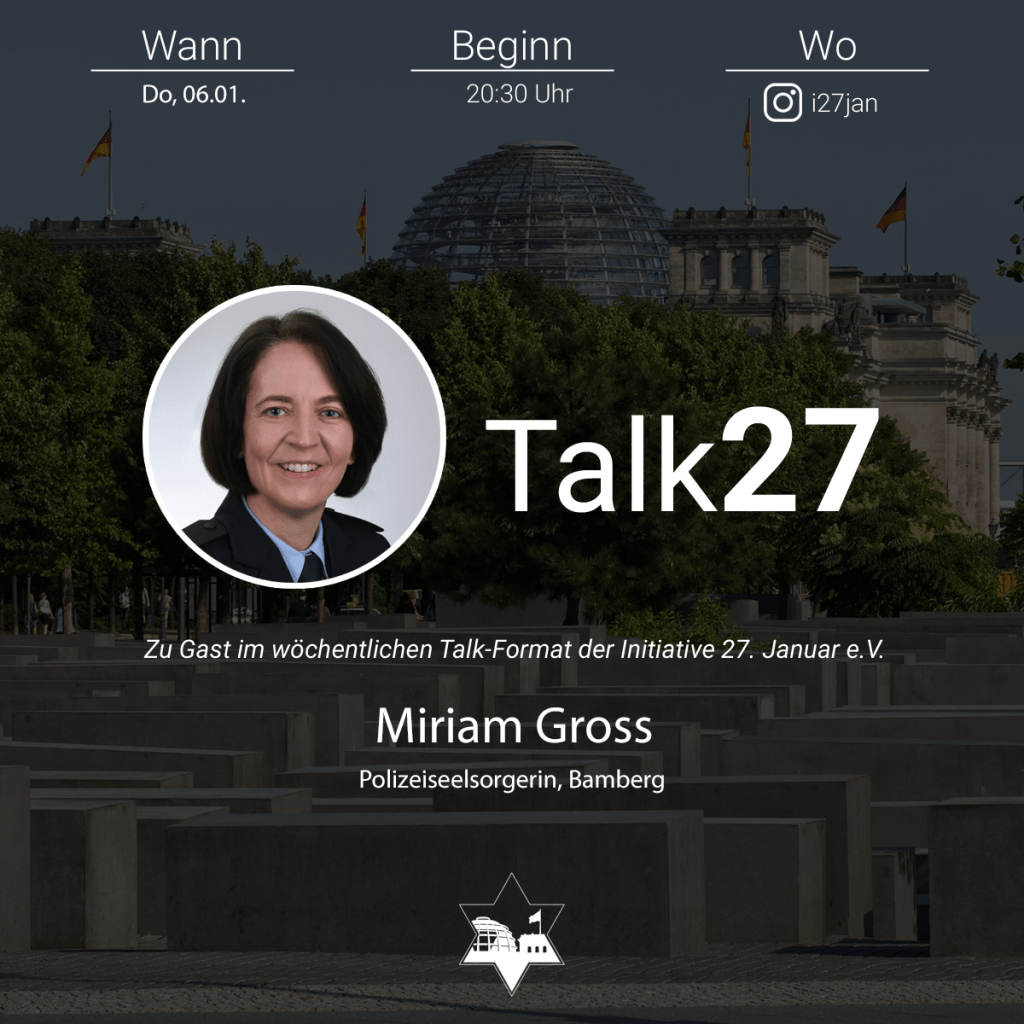
Zu Gast bei Initiative 27. Januar

Am Abend des Epiphanienfestes war ich zu Gast bei Initiative 27. Januar. Im neuen, modernen Talkformat bei Instagram durfte ich mit Herrn Matthias Böhning meine biografischen und theologischen Zugänge zu Friedens- und Versöhnungsarbeit, Rassismus und Antisemitismus in Übersee und Deutschland sprechen. Es war eine spannende Unterhaltung, die mir sehr viel Spaß gemacht hat. Ich danke Herrn Böhning sehr für diese Einladung und lege die Initiative allen Leserinnen und Lesern ans Herz! Mitmachen könnt ihr bereits jetzt ganz konkret durch die Unterstützung des Projekts „Weiße Rosen und Briefe für Holocaustüberlebende“ (Link).

Hier ist der Zugang zum Video, der auf IGTV gepostet wurde:

Grief piece by piece

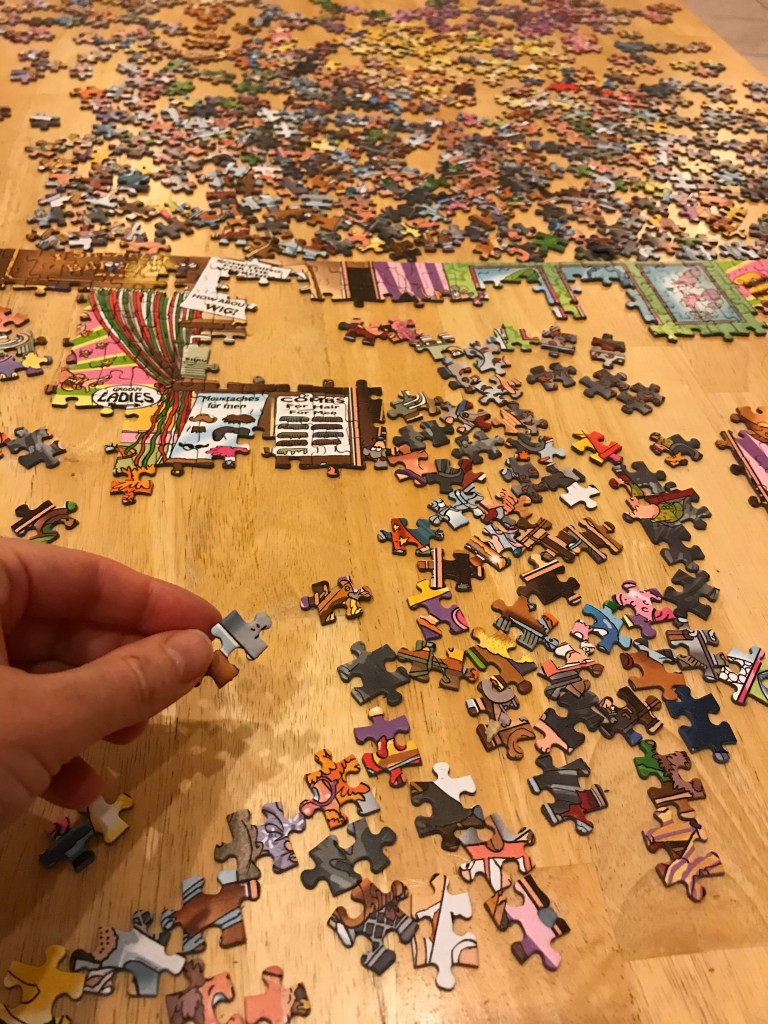
„YES!“ The small piece made a clicking sound as it found its place in the new jigsaw puzzle. It continuously took shape on the table of our sitting room leaving only a small space for other objects like a cup of milky tea. The fire was crackling in the back ground as I crouched over the mysterious picture slowly taking shape in front of me. The colorful and comic like drawing amused me as one piece after the other found its place. The displayed humor fit perfectly to the memories rising up from the depth of my soul like warm bubbles as every new puzzle piece clicked into its place.

Puzzling accompanies me and my family now almost a year. Presently, it is a sign of grief and remembrance as I feel drawn closer to one of the dearest people in my life, who I had lost too early and too quickly almost a year ago.

Just three weeks before his sudden passing away, we had spend a lovely holiday together. As we puzzled hours after hours, we talked a lot and just marveled at the gift of time, friendship and the deep connection we felt. Each time a puzzle piece found its place, he smiled accompanying it with a loud „YES!!!“. His voice still rings in my ears. As I repeated this gesture many times, yes thousands of times over the last year, it makes me feel closer to him. The memories give me strength. Life is different. It is lonely at times. His passing away has left a hole in my heart. But I have to honor his memories and his life as he is and will be an inspiration: No other person have I ever met was grounded so deeply in faith and loved so kindly beyond boundaries.

Grief is a difficult thing. I know that as a pastor as I have accompanied so many. I know it personally as I have lost numerous people dear to me. Grief needs different expressions. Mine is puzzling and evoking precious memories piece by piece.

If you out there are grieving, please be reminded that God loves you. May the memories of the loved one fill your heart and being with joy until you once meet again in God´s eternity.

____________________________________________________________________________________________

If you are curious about the puzzles, we use: The humorous puzzles are from Wasjig. They are a hilarious piece of art combined with a mystery to solve.